
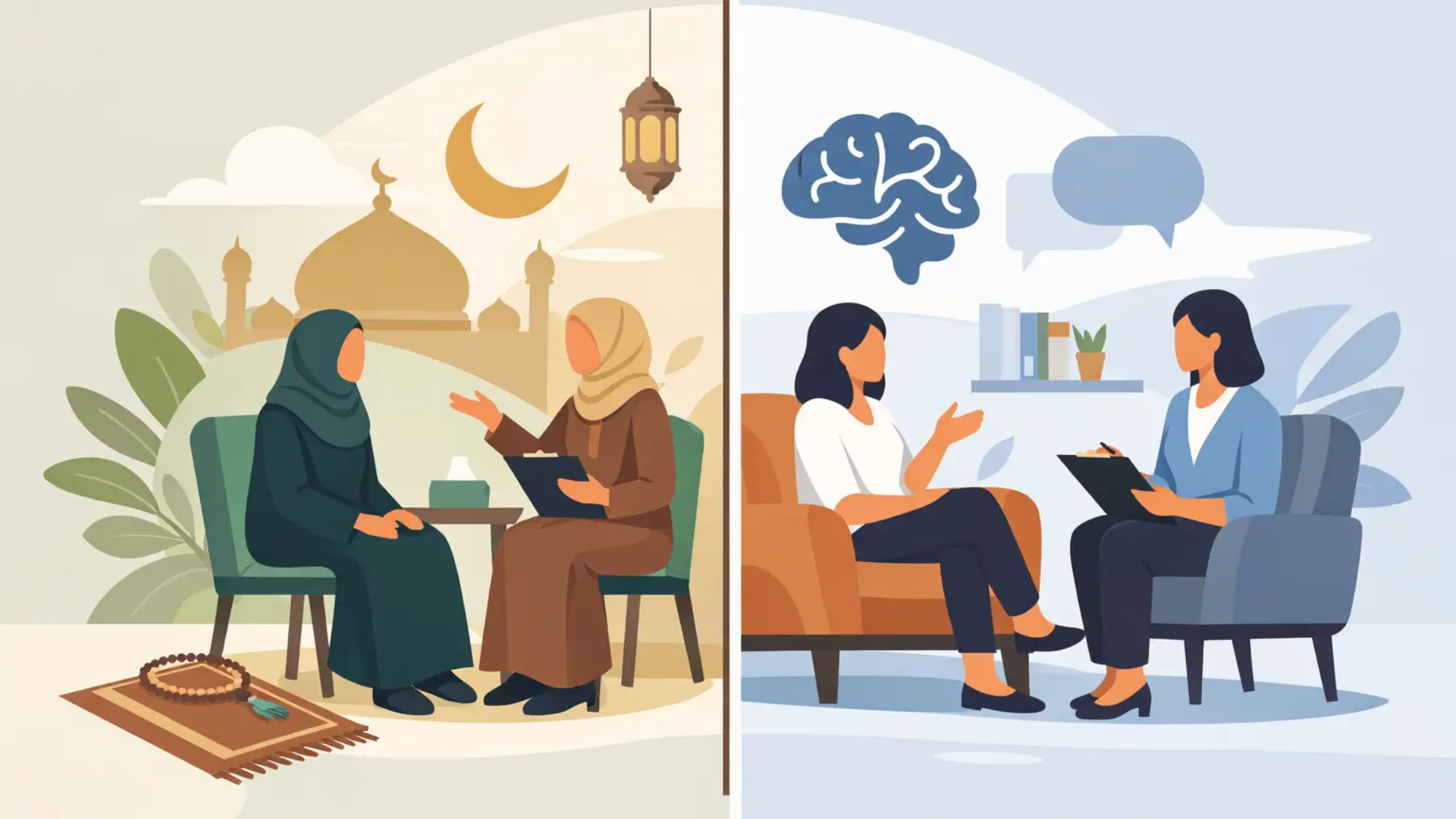
When your chest tightens during salah, when an intrusive thought makes you fear what it says about your iman, or when old trauma enters the quiet moments of your day, the question is not merely whether you need support. It is whether the support can hold the whole of you. Islamic therapy vs secular counseling is not a contest between faith and science. It is a question of whether your care understands that your mind, body, relationships, and relationship with Allah are deeply connected.
For many Muslim women, the wrong kind of support can add another burden. You may worry that a therapist will misunderstand hijab, family obligations, grief, religious practice, or the difference between healthy spiritual striving and debilitating religious OCD. You may also have been told to simply make du’a, pray more, or be patient when you were living with symptoms that deserved skilled clinical care.
You do not have to choose between serious psychotherapy and devotion to Allah.
Islamic Therapy vs Secular Counseling: The Core Difference
Both Islamic therapy and secular counseling can include ethical, evidence-based treatment for anxiety, depression, trauma, OCD, and relationship concerns. A qualified therapist in either setting should listen carefully, respect your autonomy, protect confidentiality, and use approaches appropriate to your clinical needs.
The meaningful difference is the framework through which your suffering and healing are understood. Secular counseling often works from a worldview that is intentionally nonreligious or religiously neutral. Your values may be welcomed and explored, but faith may remain a personal preference rather than an active source of meaning within treatment.
Islamically integrated therapy places faith within the therapeutic frame without replacing clinical care with religious advice. It recognizes that a Muslim woman may want to understand her healing in relation to tawakkul, repentance, mercy, justice, family ties, worship, and the hope of the Aakhirah. These are not side topics. They can shape her goals, her sense of safety, and the life she is trying to build.
This does not mean an Islamic therapist tells you what to do in every area of your life or uses scripture to override your lived experience. Good therapy does not create dependence or demand compliance. It helps you become more grounded, discerning, and able to make values-aligned choices before Allah.
When Secular Counseling May Be Helpful
A secular therapist can be deeply compassionate, clinically excellent, and respectful of Islam. Some Muslim women have transformative experiences with therapists who are not Muslim, particularly when that clinician is curious, humble, trauma-informed, and willing to learn what matters to the client.
Secular counseling may feel like a good fit when your primary concern is highly focused, such as a workplace stressor, panic symptoms, a particular relationship pattern, or grief. It may also be appropriate if you have found a therapist with specialized training that is difficult to access elsewhere, or if you prefer to keep religious discussion separate from therapy.
Still, religious neutrality has limits. A therapist may affirm your right to practice Islam without understanding how faith informs your decisions. They may not recognize that avoiding prayer due to fear of imperfection can be part of OCD rather than a lack of commitment. They may interpret boundaries with family, modesty, or marital concerns through assumptions that do not fit your moral framework.
The issue is not that secular counseling is inherently harmful. The issue is fit. You deserve a therapist who does not ask you to translate the most important parts of your life before you can begin healing.
What Faith-Integrated Care Adds
In Islamic therapy, spiritual language should be used with care, precision, and mercy. A therapist who understands both clinical treatment and Islamic tradition can help distinguish between a spiritual concern and a mental health symptom, while recognizing that they may overlap.
Consider waswasa and OCD. Intrusive thoughts can feel frightening precisely because they target what a person holds sacred. A woman may repeatedly question her wudu, prayer, intentions, or whether she has committed disbelief. Reassurance alone can unintentionally feed the OCD cycle. Telling her to pray harder may deepen shame and compulsions.
A clinically trained, Islamically grounded therapist can use Exposure and Response Prevention, or ERP, to address OCD while understanding the religious context of the fear. Treatment may involve learning to tolerate uncertainty, reduce ritual repetition, and respond to intrusive thoughts without treating them as evidence of moral failure. That is not a departure from faith. It can be a return to a more merciful and sound way of practicing it.
The same integration matters in trauma treatment. Approaches such as EMDR, Cognitive Processing Therapy, Written Exposure Therapy, Internal Family Systems, Acceptance and Commitment Therapy, CBT, and DBT can help address the nervous system effects of trauma, depression, anxiety, and chronic emotional overwhelm. An Islamic framework can also make room for questions that trauma survivors often carry: Where was Allah in this? How do I heal without minimizing what happened? What does forgiveness mean, and what does it not mean?
There are no simplistic answers to those questions. Faith-integrated therapy should never pressure someone to forgive an abuser, reconcile with an unsafe person, or endure ongoing harm in the name of sabr. Sabr is not passive acceptance of injustice. It can include seeking protection, setting limits, grieving honestly, and taking the next wise step even when the heart is tired.
Faith Integration Is Not Spiritual Bypassing
Not every therapist who uses Islamic vocabulary is practicing Islamic therapy well. It is reasonable to be cautious if a provider responds to severe symptoms only with reminders to make dhikr, read Qur’an, or strengthen iman. Worship can be profoundly regulating and sustaining, but it is not a substitute for assessment, diagnosis when appropriate, or specialized treatment.
Depression may affect sleep, concentration, appetite, energy, and the ability to feel hope. Trauma can leave the body prepared for danger long after the threat has passed. Chronic anxiety can make ordinary decisions feel unbearable. These experiences are not proof that you are spiritually deficient.
A responsible faith-integrated approach holds both truths: spiritual practices can be meaningful resources, and mental health conditions require competent care. Prayer may be part of a healing plan. So might nervous system regulation, trauma processing, behavioral activation, medication coordination with a prescriber, or exposure work for OCD. Your treatment should be individualized, not reduced to a slogan.
Questions to Ask Before Choosing a Therapist
Before scheduling, consider what you need to feel emotionally and spiritually safe. You might ask whether the therapist has experience treating your specific concern, especially if you are dealing with trauma, OCD, panic, chronic pain, or intense depression. You can also ask what evidence-based modalities they use and how they measure progress.
If Islamic integration matters to you, ask how the therapist incorporates it. Do they have enough religious fluency to understand the difference between valid religious practice and compulsive reassurance-seeking? Can they discuss family and gendered expectations without stereotyping Muslim communities? Do they know when a concern calls for psychotherapy, pastoral guidance, medical support, or a combination?
It can also help to ask about the practical container of therapy: licensure in your state, virtual appointment options, fees, scheduling, confidentiality, and what happens if symptoms worsen between sessions. Feeling connected to a therapist matters, but warmth alone is not sufficient. You are looking for both relational safety and clinical competence.
The Care You Choose Should Make Room for Your Whole Story
The best therapy is not always the therapy with the most familiar labels. A Muslim therapist is not automatically the right fit, and a non-Muslim therapist is not automatically unable to help. What matters is whether your clinician can meet the complexity of your needs with humility, skill, and respect for your deepest commitments.
At Manara Counseling, this integration means treating emotional suffering with evidence-based rigor while honoring the spiritual reality that many Muslim women do not want to leave outside the therapy room. Healing can involve reducing symptoms, yes, but it can also mean recovering your voice, relating to your body with greater compassion, practicing faith without fear, and living with clearer intention.
You are allowed to seek care that understands both the pain you carry and the sacred direction you want your life to take. The next small step toward support can be an act of courage, stewardship, and faithful return.
