
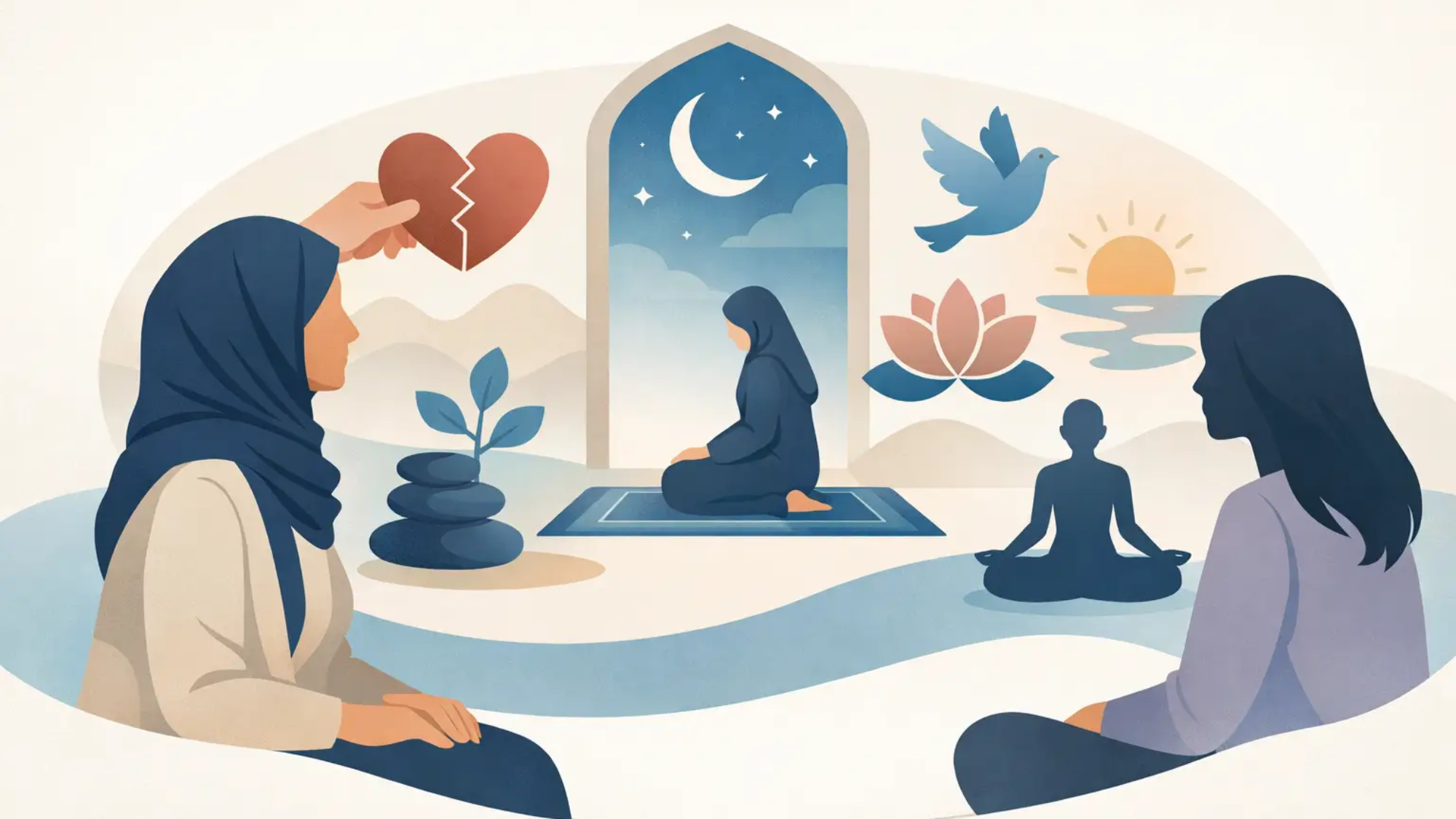
A woman can know that Allah is near and still feel her chest tighten at a familiar tone of voice. She can make du’a sincerely and still lose sleep, freeze in conflict, or carry memories her body has not yet learned are over. Islamic trauma therapy makes room for this truth: faith is not disproved by distress, and trauma is not healed by shame.
For many Muslim women, pain has been met with messages that were intended to comfort but landed as pressure: be patient, pray more, stop dwelling on the past. Sabr is sacred. Salah is a source of refuge. Yet neither should be used to deny what the nervous system has endured. A trauma-informed, Islamically grounded approach honors worship while also taking symptoms, safety, memory, and clinical treatment seriously.
What Islamic trauma therapy actually means
Islamic trauma therapy is psychotherapy that addresses the effects of trauma through evidence-based clinical care while respecting a Muslim client’s relationship with Allah, her values, and her religious language. It is not a replacement for psychotherapy with reminders alone, nor is it therapy that treats faith as irrelevant background information.
A qualified faith-integrated therapist considers how trauma may affect the brain, body, emotions, relationships, beliefs, and spiritual life. She also understands that Islamic concepts such as tawakkul, sabr, repentance, modesty, family duty, and the Aakhirah can carry deep meaning. These concepts should be approached with care, not used as shortcuts around grief, anger, fear, or a need for protection.
The goal is not to make a client less sensitive, less devoted, or more willing to tolerate harm. The goal is to help her become safer within herself, more able to choose her responses, and more connected to a life of meaning and worship.
Trauma can live in the body and the story
Trauma is not defined only by a dramatic event. It can follow assault, abuse, betrayal, a frightening medical experience, a painful loss, religious or cultural shaming, racism, immigration-related stress, or years of emotional invalidation. Sometimes the wound is tied to what happened. Sometimes it is tied to the fact that no one protected her afterward.
A person may intellectually understand that an event is in the past while her body continues to respond as if danger is present. This can look like hypervigilance, nightmares, panic, numbness, dissociation, people-pleasing, irritability, compulsive checking, or an inability to rest. It may also appear in relationships: difficulty trusting, fear of disappointing others, withdrawing from conflict, or feeling responsible for everyone else’s emotional state.
For Muslim women, trauma can become tangled with spiritual questions. Why did Allah allow this? Was I being punished? Am I sinful for feeling angry? Why can I recite Qur’an and still feel afraid? These questions deserve neither dismissal nor rushed answers. They need a setting where both theological care and clinical precision are present.
Spiritual struggle is not always a spiritual failure
Trauma can distort the way a person sees herself, others, and even Allah. A survivor may feel abandoned, contaminated, unworthy, or permanently broken. She may avoid worship because it brings up guilt, or become rigid in worship because uncertainty feels unbearable.
These experiences do not automatically indicate weak iman. They may reflect a nervous system trying to prevent further pain. Therapy can help distinguish sincere religious practice from fear-driven patterns, including trauma responses that resemble perfectionism, scrupulosity, or waswasa. That distinction matters because the intervention is different. Reassurance, exposure and response prevention, trauma processing, self-compassion, and sound Islamic guidance each have a role depending on what is maintaining the suffering.
Faith integration is not the same as spiritualizing pain
There is a meaningful difference between bringing faith into treatment and spiritualizing a clinical problem. Spiritualizing happens when a serious concern is reduced to a single religious instruction: just have sabr, just forgive, just pray more. These responses may be well-intended, but they can leave a survivor feeling unseen or guilty for having symptoms.
Faith integration asks better questions. How does her faith sustain her? Are there beliefs about suffering that offer comfort, and are there beliefs she has absorbed that deepen self-blame? Does she want Qur’anic reflection, du’a, or values-based discussion to be part of therapy? Is she safe in her home and relationships? What does healing make possible in her service to Allah and in her daily life?
A therapist should never pressure a client to disclose more than she is ready to share, forgive before she has processed what happened, or remain in an unsafe situation in the name of family harmony. Islam does not require a woman to erase her dignity to make others comfortable. Boundaries, truthful naming, and protection from harm can be part of a faithful response.
The clinical work should be specific
Compassion is essential, but trauma treatment also benefits from a clear clinical plan. The right approach depends on the nature of the trauma, current safety, dissociation, co-occurring OCD or depression, medical concerns, and the client’s own goals. There is no single method that fits every story.
EMDR can help the brain reprocess distressing memories so they no longer carry the same intensity. Cognitive Processing Therapy and Written Exposure Therapy can address trauma-related beliefs such as “It was my fault” or “I can never be safe.” Internal Family Systems may help a client meet protective parts of herself with curiosity rather than contempt. Acceptance and Commitment Therapy can support values-guided action even when painful feelings remain present.
Skills from CBT and DBT may be especially useful when trauma has left someone overwhelmed by anxiety, emotion, or relationship conflict. Grounding, pacing, sleep support, nervous-system regulation, and boundary work are not minor additions. They are often the foundation that allows deeper memory work to happen without flooding.
At Manara Counseling, this kind of care is held to both clinical and spiritual standards. Therapy can include structured assessment, collaborative goals, and evidence-based modalities while preserving room for the client’s Islamic commitments, questions, and hopes for her Aakhirah-focused life.
What a safe therapeutic relationship can offer
Many survivors are accustomed to being misunderstood. Some have been told that abuse was normal, that their pain was too much, or that seeking help would expose the family. Others have had to explain basic aspects of Islam to clinicians while trying to discuss their most vulnerable experiences.
A culturally and religiously fluent therapist does not assume that every Muslim family is the same, or that religion is the cause of harm. She makes space for complexity. She can understand why a client may care deeply about family ties while also needing limits, why modesty may shape comfort in therapy, and why a faith practice may be both a source of solace and a place where trauma has created fear.
Safety also includes therapeutic pacing. Trauma work should not feel like being pushed off a cliff. A client may first need stabilization, coping skills, and a reliable relationship with her therapist before directly processing painful memories. At other times, avoiding trauma material for too long can keep the wound active. Good treatment continually adjusts to the client’s capacity, consent, and goals.
Healing does not require erasing the past
Some women worry that healing means minimizing what occurred, becoming indifferent, or reconciling with someone who has not changed. It does not. Healing can mean remembering without being pulled back into the moment. It can mean grieving what was lost, recognizing what was unjust, and building a life that is no longer organized around survival.
It can also mean reclaiming practices that trauma complicated. A woman may return to salah with more gentleness, make du’a without treating it as a test she must perform perfectly, or recognize that Allah’s mercy was never dependent on her ability to cope without help. These are not small shifts. They can reshape the story she tells herself about her worth and her future.
If you are carrying pain that others have minimized, you do not need to prove that it was severe enough before seeking care. Your suffering is worthy of careful attention, and reaching for support can be one quiet, courageous way of returning to the life Allah created you to inhabit.

[…] Trauma can also resemble generalized anxiety. A body that has survived betrayal, abuse, medical harm, racism, displacement, or chronic emotional invalidation may remain watchful long after the original threat has passed. The goal is not to force yourself to “get over it.” The work is to help your mind and body learn, through safe and structured treatment, that the past is not still happening. […]