
Depression Help From a Muslim Therapist
About Dr. Aisha Chaudhry
Dr. Aisha Chaudhry is an Aalimah and Muslim therapist. She specializes in trauma which often looks like depression, anxiety including OCD, intrusive thoughts, health anxiety, and panic. She has a special interest in helping clients learn how to calm the body through a combination of neural informed therapies, Internal Family Systems, CBT, and Exposure-Response Prevention. For clients looking for integrated therapy, a holistic approach is available.
Depression Help from a Muslim Therapist
The information contained herein is to offer a comprehensive overview of depression (not for treatment or diagnosis) with special emphasis on what depression often looks like in some of the Muslim populations, particularly among the Muslim women I provide therapy and help to. It is important to get treatment from a Muslim therapist, particularly one who has studied Islam and who knows the Islamic rulings surrounding the issues clients seek treatment for, both clinically and Islamically. This has proven beneficial for the Muslims I care for, who have said that depression help from a Muslim therapist has been a game-changer for them. Why is this?
Therapeutic Alliance
It is important for the client to develop a good therapeutic relationship with the therapist. This can only happen if the client feels safe enough to discuss matters that they feel embarrassed about or fear they may be judged negatively due to them. Sometimes thoughts and feelings are very difficult to communicate to anyone, which is one of the reasons for lack of seeking care at all. The topics that often come up for Muslim populations are often related to what they value most, and some Muslims have felt shamed or as though they have weak beliefs because of struggling with depression.
What is Depression?
Depression is a common and sometimes serious disorder. It can cause feelings of sadness, loss of interest in activities you previously enjoyed, and can bring a sense of hopelessness.
It is very normal to feel similar feelings after experiencing a loss. We don’t consider that to be a disorder, although those feelings can increase and go on to become a disorder.
Individuals who suffer from depression often have thoughts of despair and worthlessness. They often feel low energy and as though everything is a chore. Some individuals report wanting to sleep and never really getting enough rest to feel fresh when they awaken. Further down, I list the criteria for a clinical diagnosis of depression.
Why Does Depression Come?
Depression usually comes from a mix of biological, psychological, and life factors. Sometimes individuals are prone to having a melancholy temperament, it may be partly a learned pattern, and it may be the body’s way of protecting itself.
As a Muslim therapist, what I believe is that it is our soul, body, and mind’s way of letting us know things are not okay inside. I see it as a message that somewhere in our lives there is an inner conflict.
Those messages might sound like this:
- You’re working too hard and I am forcing you to slow down by making you feel down.
- You’re not taking care of what you feel is important, so we’re going to try to balance things for you.
- There is something you need to slow down and heal from.
- There is a ‘perceived’ threat that I want to protect you from, so I’m going to slow life down for you so you don’t engage, withdraw for introspection, and focus on bare living.
- The perceived threat might sound like, “You’re not good enough, so don’t try, engage, put yourself out there, or risk it. We’re not going through ‘that’ painful thing again.”
- Your inner critic might be chattering in your head, telling you negative things and creating a constant sense of hopelessness or despair, or making you want to give up. It might seem like options aren’t available because it’s harder to see them when we’re feeling gloomy.
You might not be able to really hear those messages without getting help, but together, I will help you look inside yourself and see what messages there are to be heard, holistically and right in line with your peace and comfort.
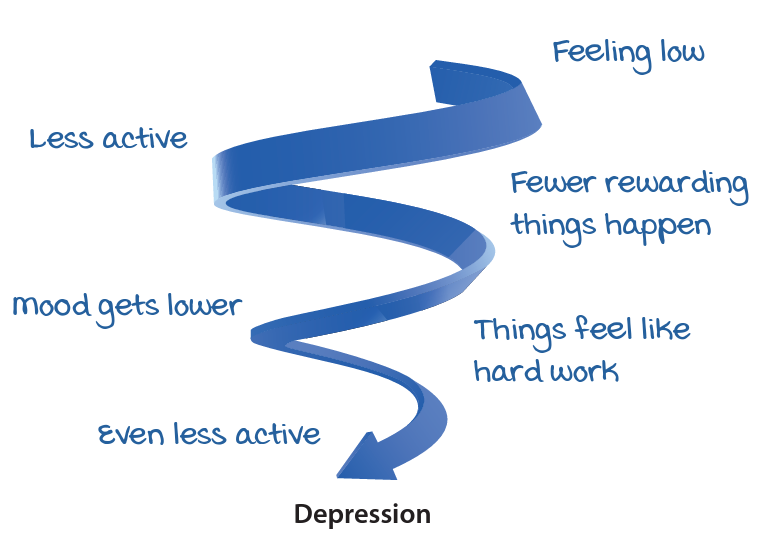
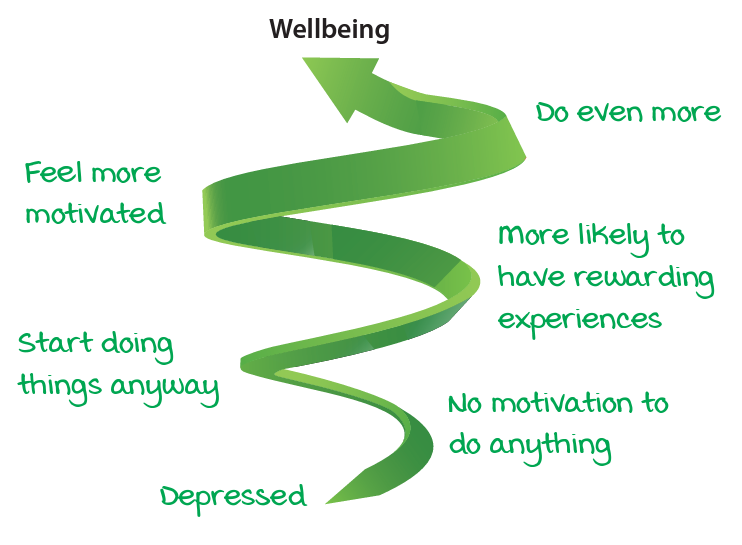
Depression creates a cycle and can feel overwhelming and hopeless to break.
Risk Factors for Depression
There is no single cause for depression. You are more likely to experience depression if you have had:
Stressful life events
These can include losses (e.g. bereavement, the end of a relationship, losing a job), transitions (e.g. leaving home, retiring, having a baby), physical illness, loneliness, or any other significant, traumatic, or stressful events.
A habit of thinking negatively
More than just a pessimistic attitude, these are patterns of automatically seeing the worst in things (“glass-half-empty thinking”), blaming yourself, or discounting your achievements.
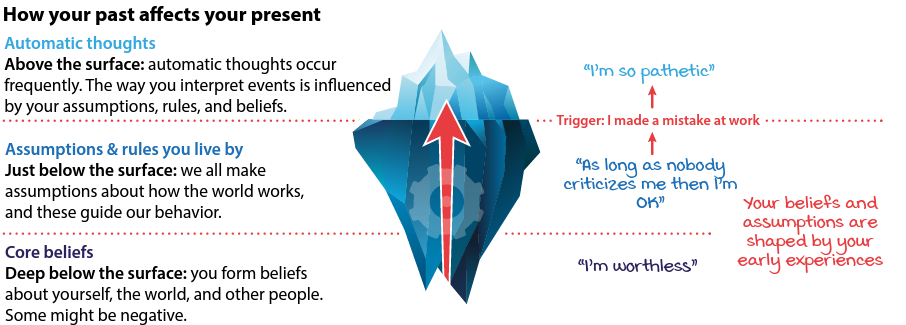
Early experiences
These can include poverty and deprivation, abuse, neglect, bullying, poor relationships, or living with a parent who was preoccupied and dealing with their own difficulties.
Genetic predisposition
Depression tends to run in families, and genes account for part of the risk. However, there is no single “depression gene”; many genes each play a small role, together with life experiences.
Medical conditions & substances
Some medical conditions, prescription drugs, alcohol, and other substances can create symptoms in line with depression.
Vitamin & mineral deficiencies
Deficiencies such as low vitamin D or B12 can contribute to or mimic depressive symptoms, so it is always important to rule those out if you have symptoms of depression.
Inflammation
Inflammation in the body due to foods, allergies, or other health conditions has been linked with depression in research. This is an active area of study, and reducing inflammation may help some people as part of their overall care.
Symptoms of Depression
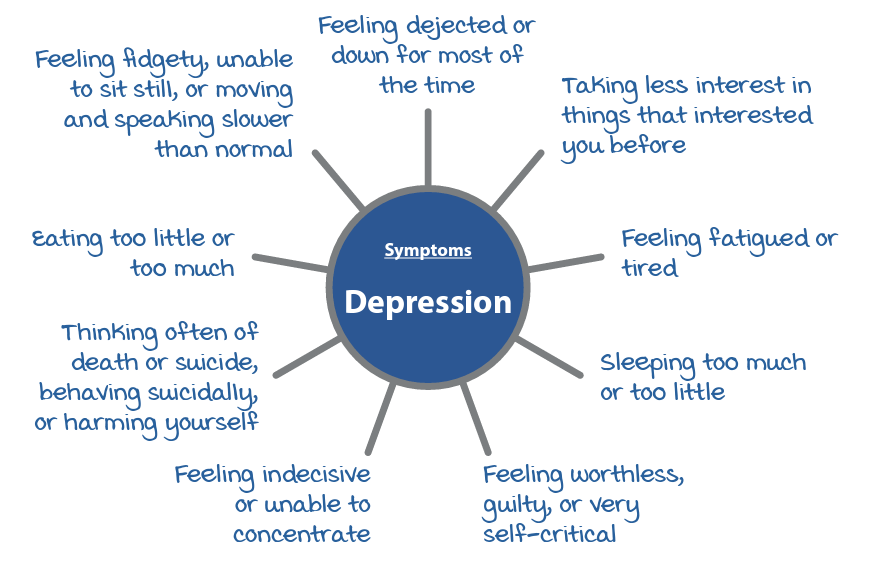
What Individuals With Depression Say
My clients often describe their symptoms as a lack of desire to get up and do normal things. Of course, how much they feel depends on the severity of their depression. On the other hand, some clients share that few people, if any, would ever know they are struggling because they mask their symptoms so well. It is important to be assessed because depression, and what it looks like in life, can vary vastly.
Individuals often say things like:
- I feel like giving up.
- I feel like nothing is or is ever going to get better.
- A week or so before my period comes, I can’t stop crying, or I feel like I want to rip off people’s heads.
- I get mood swings around the middle of the month or around my period, but no other times.
- I feel sad in the wintertime.
- I am too tired to really put in the effort.
- It’s a chore to pray and do everything.
- No one cares or loves me.
- Allah probably won’t even forgive me at this point.
- No one will ever like or love me.
- I am not good enough to be like others.
- Everyone’s so much better than me, why should I even try?
- I feel so guilty that I’m not living the life I want, or that I should have.
- I don’t think I should even try.
- I should be doing so many things.
- No one ever feels like I’m worth it.
- I just can’t get my work done.
- No matter what I try, I can’t make myself feel better or snap out of it.
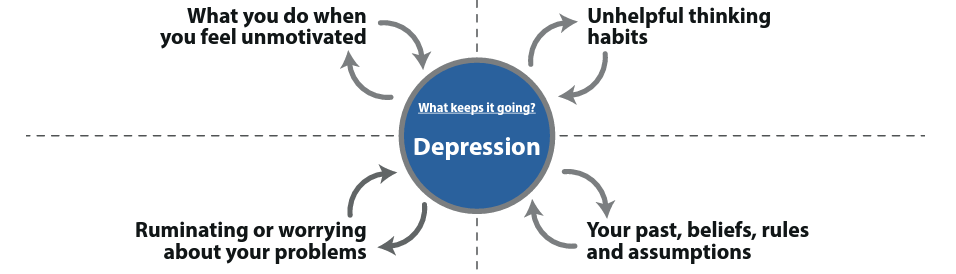
Don’t Believe Everything You Think
Just because you think it, or others even say it – it does not make it true! Sometimes we give so much weight to things we or others seem to think that it can really start carving away our wellbeing and happiness.
Sometimes we even get “comparitis” – where we feel like we need to keep up with others because of what others think we should be, or how we’ve somehow concluded we need to be. This can be found in families who are very conscious of cultural and religious expectations.
Sometimes we make up a lot of rules for what needs to happen in order for us to feel better. We buy into them so much, and yet no one can bear that weight. We need to step back and see what kind of rules we have made in life, and what kind of rules we are imposing on others to follow as well, so that we can feel better. What we need and what we want can often look like two different things. We can be well, even in situations that seem impossible.
Schedule AppointmentAm I a Bad Muslim?
Every time someone asks me this, a part of my heart breaks. The answer is no, you are not a bad Muslim. You are not bad. The next question that is often asked is, “Even if I am not doing my prayers or other worship (ibadah) so well?” and “Will Allah forgive me?”
No, struggling does not make you a bad Muslim, and Allah’s mercy is vast. He forgives those who turn back to Him, even when you’re not praying or doing other things like you feel you should.
Say, “O My servants who have transgressed against themselves, do not despair of the mercy of Allah. Indeed, Allah forgives all sins. Indeed, it is He who is the Forgiving, the Merciful.”
Surah Az-Zumar (39:53)
A lot of times, Muslims have been made to feel shame, guilt, or embarrassment because others feel their religious commitment is not where it ‘should’ be, and that creates so much distress. Some people say there is no huzn (grief, despair, depression, or sadness) for Muslims, or believe they should never experience it. Yet even Prophet Ya’qub (peace be upon him) grieved deeply and said, “I only complain of my suffering and my grief to Allah” (Qur’an 12:86).
This is exactly why I would encourage you to work with me. As a Muslim therapist and Aalimah, I will help you understand what is happening in a holistic manner so you feel empowered and not powerless, hopeless, and shamed.
I can imagine that for someone who already feels down and bad about how they are feeling, and about their perceived lapse in not being good enough, not doing things well enough, or not feeling intense love for Allah (subhanahu wa ta’ala), shaming them is not going to help them feel inspired and empowered to lift themselves up.
As a Muslim therapist and Aalimah, I will accept you for who you are, where you are, and help you toward where you want to be. I will hold that space for you unconditionally.
Somewhere along the line you may have developed a “core” belief that you’re bad, based on something that happened to you, and you never really worked it out and balanced it off. Take a look at the graphic below to see how core beliefs are made and how they shape life experiences.
Diagnosing Depression
To diagnose depression, I use the criteria specified by the American Psychiatric Association (APA). Additionally, I use one or more assessment instruments to create a baseline of symptoms and their severity. This helps us know where we are starting so that we know if we are progressing. However, as a Muslim therapist who has experience in treating depression, I will look at the totality of a person in relation to your lifestyle, culture, and practices.
In summary, the criteria for Major Depressive Disorder are:
Five or more symptoms for at least two weeks
Five or more of the following have been present during the same two-week period and are a change from previous functioning. At least one is depressed mood or loss of interest or pleasure.
- Depressed mood most of the day, nearly every day (for example feeling sad, empty or hopeless; in children and teens, irritability)
- Markedly reduced interest or pleasure in all or almost all activities
- Significant weight loss or gain when not dieting, or a change in appetite
- Sleeping too little or too much
- Restlessness or slowed movement that others can notice
- Fatigue or loss of energy
- Feelings of worthlessness or excessive or inappropriate guilt
- Trouble thinking, concentrating, or making decisions
- Recurrent thoughts of death, thoughts of suicide, or a suicide attempt or plan
Significant distress or impairment
The symptoms cause clinically significant distress or difficulty in social, work, or other important areas of life.
Not due to a substance or medical condition
The episode is not caused by a substance or another medical condition. Grief after a significant loss can look similar; a clinician carefully considers whether depression is also present.
Not better explained by another condition
The episode is not better explained by another mental health condition (the therapist will rule those out).
No history of mania or hypomania
There has never been a manic or hypomanic episode, which would point toward a bipolar condition instead.
To be specified: mild, moderate, or severe.
Summarized in plain language from the American Psychiatric Association’s DSM-5-TR. Only a qualified professional can make a diagnosis.
Treating Depression
of people with depression eventually respond well to treatment (American Psychiatric Association).
sessions often bring significant improvement.
Depression is among the most treatable of mental disorders. Between 80% and 90% of people with depression eventually respond well to treatment. Almost all patients gain some relief from their symptoms.
Before a diagnosis or treatment, a health professional should conduct a thorough diagnostic evaluation, including an interview and a physical examination. In some cases, a blood test might be done to make sure the depression is not due to a medical condition like a thyroid problem or a vitamin deficiency (reversing the medical cause would alleviate the depression-like symptoms). The evaluation will identify specific symptoms and explore medical and family histories as well as cultural and environmental factors, with the goal of arriving at a diagnosis and planning a course of action.
Psychotherapy
Psychotherapy, or “talk therapy,” is sometimes used alone for treatment of mild depression; for moderate to severe depression, psychotherapy is often used along with antidepressant medications. Cognitive behavioral therapy (CBT) has been found to be effective in treating depression. CBT is a form of therapy focused on problem solving in the present. CBT helps a person to recognize distorted or negative thinking, with the goal of changing thoughts and behaviors to respond to challenges in a more positive manner. Behavioral Activation, which gradually rebuilds meaningful and rewarding activities, is another well-researched approach.
Psychotherapy may involve only the individual, but it can include others. For example, family therapy can help address issues within close relationships. Group therapy brings people with similar struggles together in a supportive environment and can help participants learn how others cope in similar situations.
Depending on the severity of the depression, treatment can take a few weeks or much longer. In many cases, significant improvement can be made in 10 to 15 sessions.
Electroconvulsive Therapy
ECT is a medical treatment that has been most commonly reserved for patients with severe major depression who have not responded to other treatments. It involves a brief electrical stimulation of the brain while the patient is under anesthesia. A patient typically receives ECT two to three times a week for a total of six to 12 treatments. It is usually managed by a team of trained medical professionals, including a psychiatrist, an anesthesiologist and a nurse or physician assistant. ECT has been used since the 1940s, and many years of research have led to major improvements and the recognition of its effectiveness as a mainstream rather than a “last resort” treatment.
Medication
Brain chemistry may contribute to an individual’s depression and may factor into their treatment. For this reason, antidepressants might be prescribed to help modify one’s brain chemistry. These medications are not sedatives, “uppers” or tranquilizers. They are not habit-forming. Generally, antidepressant medications have no stimulating effect on people not experiencing depression.
Antidepressants may produce some improvement within the first week or two of use, yet full benefits may not be seen for two to three months. If a patient feels little or no improvement after several weeks, his or her psychiatrist can alter the dose of the medication or add or substitute another antidepressant. In some situations, other psychotropic medications may be helpful. It is important to let your doctor know if a medication does not work or if you experience side effects.
Psychiatrists usually recommend that patients continue to take medication for six or more months after the symptoms have improved. Longer-term maintenance treatment may be suggested to decrease the risk of future episodes for certain people at high risk.
As a therapist, I don’t decide whether individuals must take medication. For mild depression, we often begin with therapy. For moderate to severe depression, or if after a few sessions I don’t see improvement in the ability to engage in therapy, I refer to a psychiatrist for an evaluation alongside our work. I always invite the client to decide their care every step of the way. Nothing is ever forced on a client.
Natural Remedies
Some individuals may be interested in knowing how to treat depressive symptoms themselves without taking medications prescribed by a psychiatrist. First, I would encourage you to go through the intake process to see if you have a disorder and, if so, which kind and severity. Maybe a few adjustments are all you need, and we’ll open that up to really see your unique needs.
Steps you can take before your intake appointment, though not necessary, include:
- Getting your thyroid panel checked by your doctor, as thyroid problems are known to cause fatigue, body pain, sadness, and other depressive symptoms.
- Checking your vitamin D and other vitamins and minerals, as deficiencies can cause depressive symptoms.
- Ruling out any medical conditions related to the stomach that may prevent proper absorption of nutrients.
- According to Harvard Medical School, omega-3 fatty acids may improve depressive symptoms for some people, though research results are mixed. Read more.
- Gut health and reducing inflammation in the body through omega-3 fatty acids and an anti-inflammatory diet can help. Read more.
WARNING: Please do not self-medicate. Supplements such as 5-HTP, St. John’s wort, or L-tyrosine can interact dangerously with antidepressants and other medications (for example, causing serotonin syndrome) and can trigger manic symptoms in some people. Always talk with your doctor or pharmacist before starting any supplement.
Self-Help, Family Members & Friends Support
There are a number of things people can do to help reduce the symptoms of depression. For many people, regular exercise helps create positive feelings and improves mood. Getting enough quality sleep on a regular basis, eating a healthy diet and avoiding alcohol (a depressant) can also help reduce symptoms of depression.
Other means include seeking religious connection and attending religious talks where hope and encouragement can be found. Small activities that can provide spurts of pleasure, encouragement, and a source of energy are highly advised.
Family members and friends can encourage by listening without judging, and encouraging engagement and activities according to your energy level.
Depression is a real illness and help is available. With proper diagnosis and treatment, the vast majority of people with depression will overcome it. If you are experiencing symptoms of depression, a first step is to see your family physician or psychiatrist. Talk about your concerns and request a thorough evaluation. This is a start to addressing your mental health needs.
Keep Reading
Hope can grow again
Book a free 15-minute meet & greet to ask your questions and see whether working with Dr. Aisha is the right fit.
Book a Free Meet & GreetDisclaimer
None of the information on this website is intended to diagnose or treat any condition. This information is for educational use only. Please get treatment if you feel you are struggling with different symptoms. If you are in crisis, call or text 988 (in the US), call your local emergency number, or go to the nearest emergency room.