
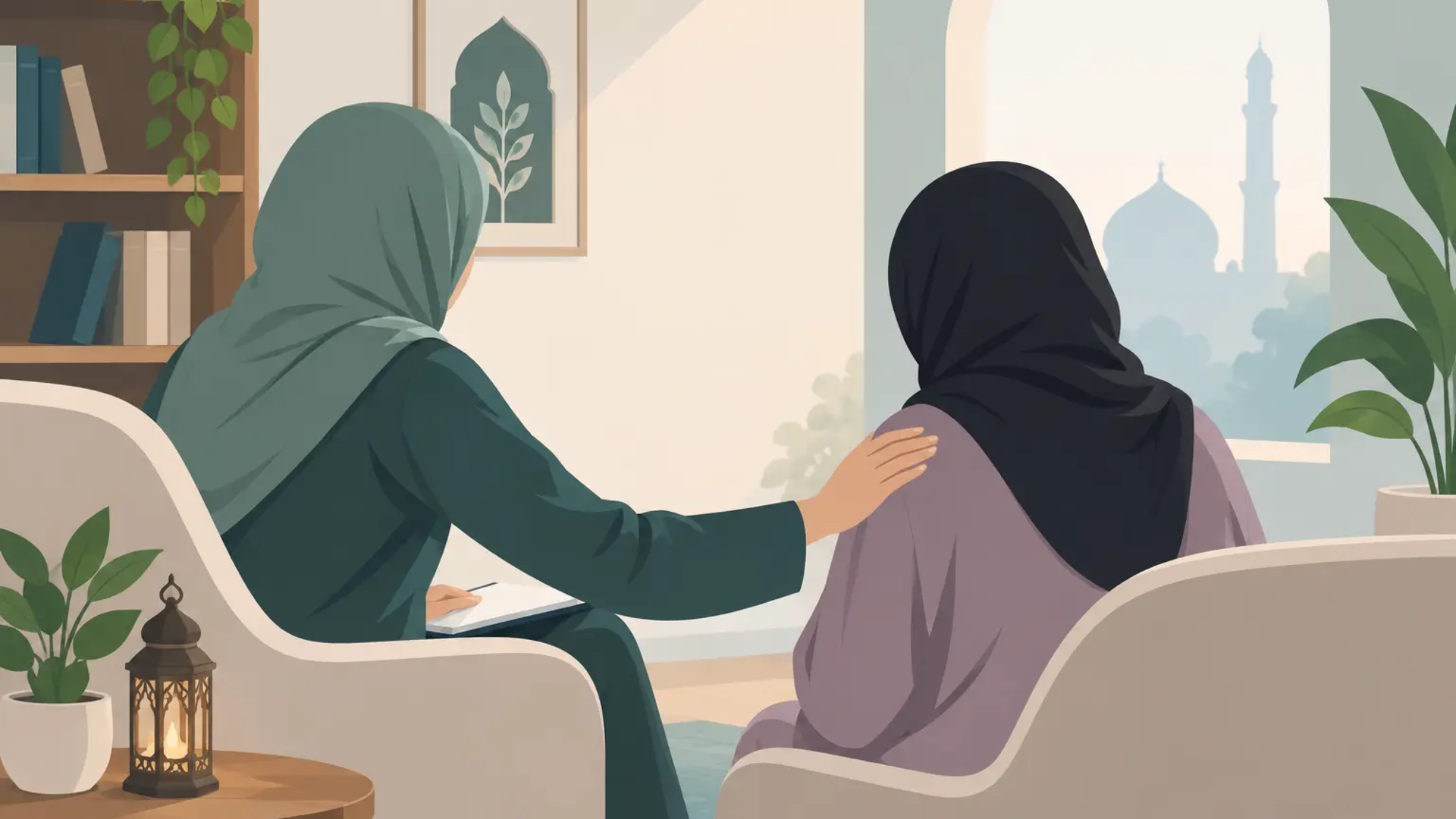
Some wounds are carried so quietly that others mistake them for personality. You may be the dependable daughter, the capable professional, the woman who shows up for everyone else, while your body braces at a raised voice, a certain smell, an unanswered message, or a moment of conflict. Trauma counseling offers a place to understand these responses without shame. It recognizes that what happened to you, or what your nervous system learned to expect, may still be shaping your life.
For Muslim women, healing can hold an added complexity. You may deeply love Allah and still feel afraid, numb, angry, exhausted, or unable to move past an experience. These realities do not cancel each other out. Faith is not a test you fail because your body remembers pain. Thoughtful therapy can honor your devotion while providing the clinical care needed to help your mind and nervous system recover.
What Trauma Can Look Like Beyond One Event
Trauma is not limited to a single catastrophic event. It can follow abuse, assault, a frightening medical experience, sudden loss, a serious accident, or witnessing harm. It can also develop through repeated experiences of humiliation, neglect, betrayal, coercion, chronic criticism, racism, family instability, or emotional unsafety.
Sometimes a woman says, “Nothing was bad enough for me to call it trauma.” Yet she cannot relax, trust her own judgment, sleep peacefully, or feel fully present in her relationships. The question is not whether your experience compares to someone else’s. A more useful question is this: what did your system have to do to survive it?
The answers may appear as hypervigilance, people-pleasing, panic, dissociation, intrusive memories, nightmares, irritability, perfectionism, emotional shutdown, or a persistent sense that something terrible is about to happen. Trauma can also intensify OCD, anxiety, depression, chronic pain, or difficulties with food, intimacy, and self-worth.
These patterns are not proof that you are weak or spiritually deficient. They are often protective adaptations. Your nervous system learned to scan, avoid, freeze, appease, or disconnect because those strategies once helped you endure what felt unsafe. Healing does not require you to hate those protective parts of yourself. It asks you to help them recognize that the danger is not still happening.
What Trauma Counseling Actually Involves
Effective trauma counseling is not simply retelling painful memories until they hurt less. For some people, recounting everything too quickly can increase distress and reinforce overwhelm. Good trauma treatment is paced, collaborative, and grounded in safety.
Early work may focus on helping you understand your symptoms and build skills for regulation. This can include noticing body cues, practicing grounding, strengthening boundaries, improving sleep, and learning how to return to the present when a memory or trigger takes over. You remain an active participant in decisions about the pace and direction of therapy.
When it is clinically appropriate, therapy can then help you process the experiences that remain stuck. Evidence-based approaches work differently, and the best fit depends on your history, symptoms, goals, and readiness. EMDR may help the brain reprocess distressing memories that still feel immediate. Cognitive Processing Therapy can address beliefs formed after trauma, such as “It was my fault” or “I can never be safe.” Written Exposure Therapy offers a structured way to approach traumatic memories. Internal Family Systems can help you relate compassionately to the protective parts of you that developed around pain.
For women living with trauma-related avoidance, anxiety, or intrusive thoughts, treatment may also incorporate CBT, ACT, DBT, or exposure-based work. The modality matters, but the therapeutic relationship matters too. You deserve a clinician who is attentive to your safety, transparent about the process, and skilled enough to know that healing is not linear.
Faith-Integrated Trauma Counseling Is Not Simplistic Advice
A faith-integrated approach does not use religion to bypass grief, fear, or anger. Telling a traumatized person to “just make du’a,” “have more sabr,” or “forgive and forget” can add guilt to an already heavy burden. Salah, Qur’an, dhikr, du’a, and reliance on Allah can be profound sources of grounding and meaning. They are not substitutes for careful assessment, nervous system education, or trauma-focused treatment when those are needed.
In faith-integrated care, Islamic teachings can become part of a fuller healing framework. You may explore how trauma affected your relationship with trust, your body, family roles, worship, or your sense of Allah’s nearness. You may grieve what was taken from you while also rebuilding a life shaped by your values.
This work requires nuance. For example, forgiveness may be spiritually meaningful for some women, but it does not require reconciliation, renewed access, silence about harm, or abandoning wise boundaries. Honoring parents does not mean accepting abuse. Patience does not mean remaining in danger. A therapist who understands both clinical trauma care and Islamic ethical language can help distinguish between devotion and self-erasure.
Signs You May Be Ready to Seek Support
You do not need to wait until you are in crisis to begin therapy. Trauma counseling may be worth considering if the past repeatedly intrudes on the present, if you organize your life around avoiding reminders, or if your reactions feel larger than the moment in front of you.
It may also help when you have done your best to “move on” but still feel disconnected from yourself. Perhaps you understand the story intellectually, yet your body does not believe you are safe. Perhaps you are successful on paper but cannot receive tenderness without discomfort. Perhaps worship has become harder because stillness makes painful memories louder. These are not failures of character. They are meaningful clinical signals.
If you are currently in an unsafe situation, immediate safety comes before memory processing. Therapy can support planning, boundaries, and resources, but no treatment should pressure you to confront trauma while active harm continues. Likewise, if you are experiencing thoughts of harming yourself or feel unable to stay safe, seek urgent local crisis support or emergency care right away.
How to Choose a Trauma Counselor
The right counselor should be able to explain how they assess trauma and how they decide which treatment approach fits. Ask whether they have specific training in trauma-focused modalities, how they handle dissociation or emotional flooding, and what stabilization looks like before deeper processing begins.
For Muslim women, cultural and religious fluency can change the experience of being understood. You should not have to spend half of each session translating the significance of modesty, family obligation, waswasa, marriage expectations, community dynamics, or your longing to please Allah. At the same time, shared faith identity alone is not enough. Look for sound clinical training, clear boundaries, and an approach that does not minimize your pain in the name of spirituality.
Online therapy can be especially meaningful when it gives you access to a female Muslim clinician with specialized training that may not be available locally. Privacy still matters. Consider where you will take sessions, whether you can speak freely, and what practical support may help you protect that time.
Healing Is a Return to Choice
Trauma narrows life. It can make the past feel like a prophecy, convincing you that every relationship will repeat the same harm or that your body will always belong to fear. Trauma treatment widens the space between a trigger and your response. Over time, you may notice that you can rest without scanning, say no without spiraling, remember without reliving, and worship from love rather than pressure.
This does not mean the past becomes acceptable. It means the past no longer gets the final word over who you are becoming. With compassionate, clinically grounded support, healing can become an act of returning: to your body, to your voice, to your capacity for wise choice, and to Allah with a heart that is learning it does not have to survive alone.
