
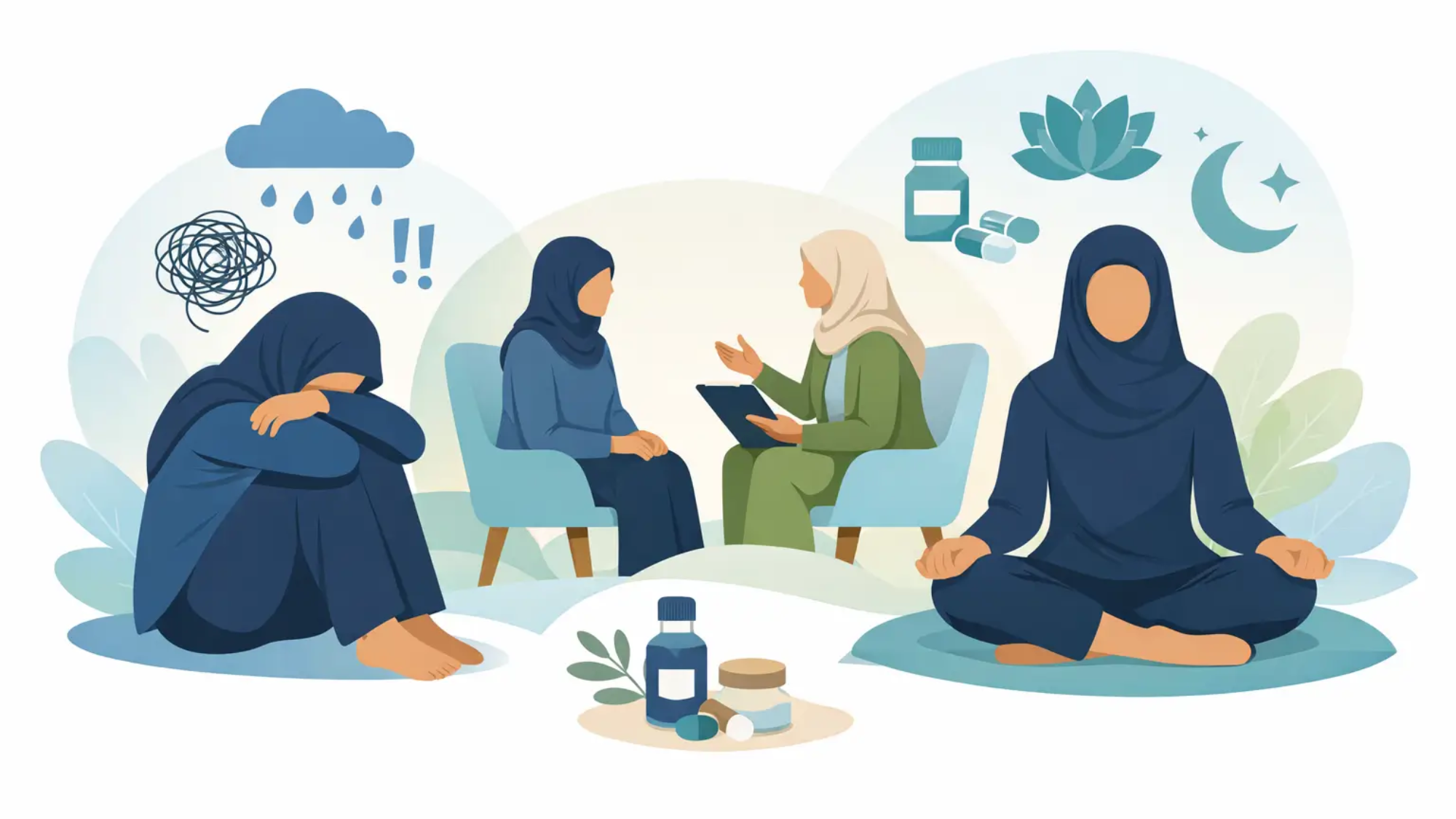
You may be the woman who gets through the day, answers the messages, prepares the meals, prays, works, and cares for everyone else – while your chest stays tight and your mind never fully rests. You may even wonder whether you are failing spiritually because anxiety has followed you into salah, sleep, family life, or decisions that should feel ordinary. Muslim women anxiety treatment options should never require you to choose between taking your symptoms seriously and honoring your relationship with Allah.
Anxiety is not proof of weak iman. It can be a nervous system response shaped by stress, trauma, uncertainty, biology, loss, perfectionism, or years of carrying more than your share. Faith can be a profound source of meaning and support. It is not, however, a substitute for compassionate clinical care when your mind and body are signaling that they need help.
Muslim women anxiety treatment options: start with clarity
Anxiety is a broad word. For one woman, it may look like chronic worry that moves from health to marriage to finances without ever settling. For another, it may be panic symptoms, racing thoughts, insomnia, irritability, or a body that feels constantly braced for danger. For someone else, intrusive religious thoughts and repeated checking may point toward OCD rather than ordinary worry.
This distinction matters because the most helpful treatment depends on what is actually happening. A therapist should take time to understand your symptoms, history, values, physical health, relationships, and the situations that make anxiety worse or keep it going. A good assessment does not reduce you to a diagnosis. It gives you a more accurate map for healing.
For example, anxiety after a frightening event may require trauma-focused work. Anxiety driven by relentless “what if” thoughts may respond well to cognitive and behavioral strategies. When intrusive thoughts, washing, reassurance-seeking, repeated repentance, or ritual repetition are present, OCD-specific treatment may be needed. Calling all of these experiences simply “waswasa” can delay care and deepen shame.
Evidence-based therapy can make room for faith
Psychotherapy is often the foundation of anxiety treatment. It offers a protected space to understand what your nervous system has learned, practice new responses, and build a life that is not organized around fear. For Muslim women, the right therapeutic relationship also makes it possible to speak honestly about family expectations, modesty, community pressures, religious scrupulosity, grief, identity, and the desire to please Allah without being judged or misunderstood.
Cognitive behavioral therapy for anxious thinking
Cognitive behavioral therapy, or CBT, helps identify patterns that intensify anxiety. This might include catastrophizing, mind-reading, all-or-nothing thinking, or treating a frightening thought as a certainty. The goal is not to force yourself into shallow positivity. It is to test anxious predictions, develop more balanced interpretations, and choose actions based on values rather than alarm.
CBT can be especially useful when worry has narrowed your world. If you have stopped driving, making phone calls, attending gatherings, applying for opportunities, or making decisions because you fear the outcome, therapy can help you gradually re-enter what anxiety has taken from you.
Acceptance and commitment therapy for a values-led life
Acceptance and commitment therapy, or ACT, takes a different but complementary approach. Rather than trying to eliminate every distressing thought, ACT teaches you how to make room for internal discomfort without allowing it to control your next step.
This can resonate deeply with a faith-centered life. You can acknowledge, “I feel afraid,” while still choosing a response rooted in your values: honesty, family connection, service, health, worship, or trust in Allah. Acceptance is not resignation. It is the practice of no longer spending your whole life in a struggle with thoughts and sensations that may come and go.
Exposure and response prevention for OCD and religious scrupulosity
When anxiety is fueled by OCD, reassurance and repeated rituals can bring short-term relief while strengthening the cycle over time. Exposure and response prevention, or ERP, is a highly effective treatment that helps a person face feared triggers in gradual, intentional ways and resist compulsions.
For Muslim women experiencing religious OCD, this work must be handled with both clinical precision and religious fluency. The treatment is not asking you to become careless about your deen. It is helping you distinguish sincere worship from compulsions driven by fear and doubt. A therapist who understands Islamic practice can help ensure that treatment does not confuse clinical recovery with religious compromise.
Trauma-focused therapies when the body still feels unsafe
Some anxiety begins long after the original danger has passed. Childhood instability, emotional abuse, discrimination, medical trauma, grief, betrayal, or a frightening birth experience can leave the nervous system expecting harm. You may understand logically that you are safe, yet still freeze, over-explain, people-please, shut down, or become intensely vigilant.
Trauma-focused approaches such as EMDR, Written Exposure Therapy, Cognitive Processing Therapy, and Internal Family Systems-informed work can help process experiences that remain stored as present-day threat. The right modality depends on your history, stability, symptoms, and readiness. Trauma treatment should not rush disclosure or ask you to relive pain without sufficient support.
Medication may be one part of care
For moderate to severe anxiety, medication can be a helpful option alongside therapy. A primary care clinician or psychiatric prescriber can discuss whether medication may reduce symptoms enough for you to sleep, function, and engage more fully in treatment. This is a personal medical decision, not a measure of your faith or strength.
Medication is not right for every person, and finding the right fit can take time. Discuss potential benefits, side effects, pregnancy or breastfeeding considerations, other health conditions, and your preferences with a qualified prescriber. Some women use medication temporarily; others benefit from it longer term. The appropriate plan depends on your symptoms and circumstances.
Spiritual grounding should support treatment, not replace it
Prayer, dhikr, Qur’an, dua, community, and a sincere return to Allah can steady the heart in ways clinical language cannot fully capture. They can also give treatment a deeper purpose. Healing is not only about feeling less anxious. It can be about becoming more present in your worship, more available to people you love, and more able to live the life Allah has entrusted to you.
Yet spiritual practices should not become another standard you use to punish yourself. If you are exhausted, struggling to focus, or feeling numb, the answer is not to accuse yourself of not praying hard enough. Gentle consistency is often more healing than pressure. A faith-integrated therapist can help you draw from spiritual resources without turning them into compulsive reassurance or another impossible demand.
What culturally aligned care can feel like
You deserve care where you do not have to translate every part of your world before you can discuss your pain. That may mean working with a Muslim woman therapist, a clinician familiar with Islamic concepts, or someone who respectfully asks what faith means in your healing rather than making assumptions about it.
Cultural alignment is not merely about shared identity. It is about safety, clinical skill, and the ability to recognize when family loyalty, gendered expectations, immigration history, racism, or community stigma are shaping anxiety. It is also about honoring your agency. A therapist should not tell you what Islam requires of you outside their scope, nor dismiss faith as irrelevant. At Manara Counseling, this integration is approached with both evidence-based clinical training and Islamic scholarship.
Choosing your next step
Begin by noticing the cost of anxiety. Is it disrupting sleep, concentration, worship, relationships, work, appetite, or your ability to leave the house? Has it been present most days? Are you avoiding more and more of your life? Those are meaningful signs that support may be warranted.
When looking for a therapist, ask whether they treat anxiety, OCD, trauma, or panic specifically; what approaches they use; whether they offer virtual care in your state; and how they integrate faith when a client wants that. You are allowed to ask direct questions before committing to therapy. The relationship matters, and it may take more than one consultation to find a clinician who feels like a trustworthy fit.
If you are having thoughts of harming yourself, feel unable to stay safe, or are in immediate danger, seek urgent local support through emergency services, a crisis line, or the nearest emergency department.
Your anxiety may be loud, but it is not the whole story of who you are. Seeking treatment can be one quiet, courageous act of amanah: caring for the mind and body Allah has entrusted to you, so you can return to your life with greater steadiness, mercy, and room to breathe.
