
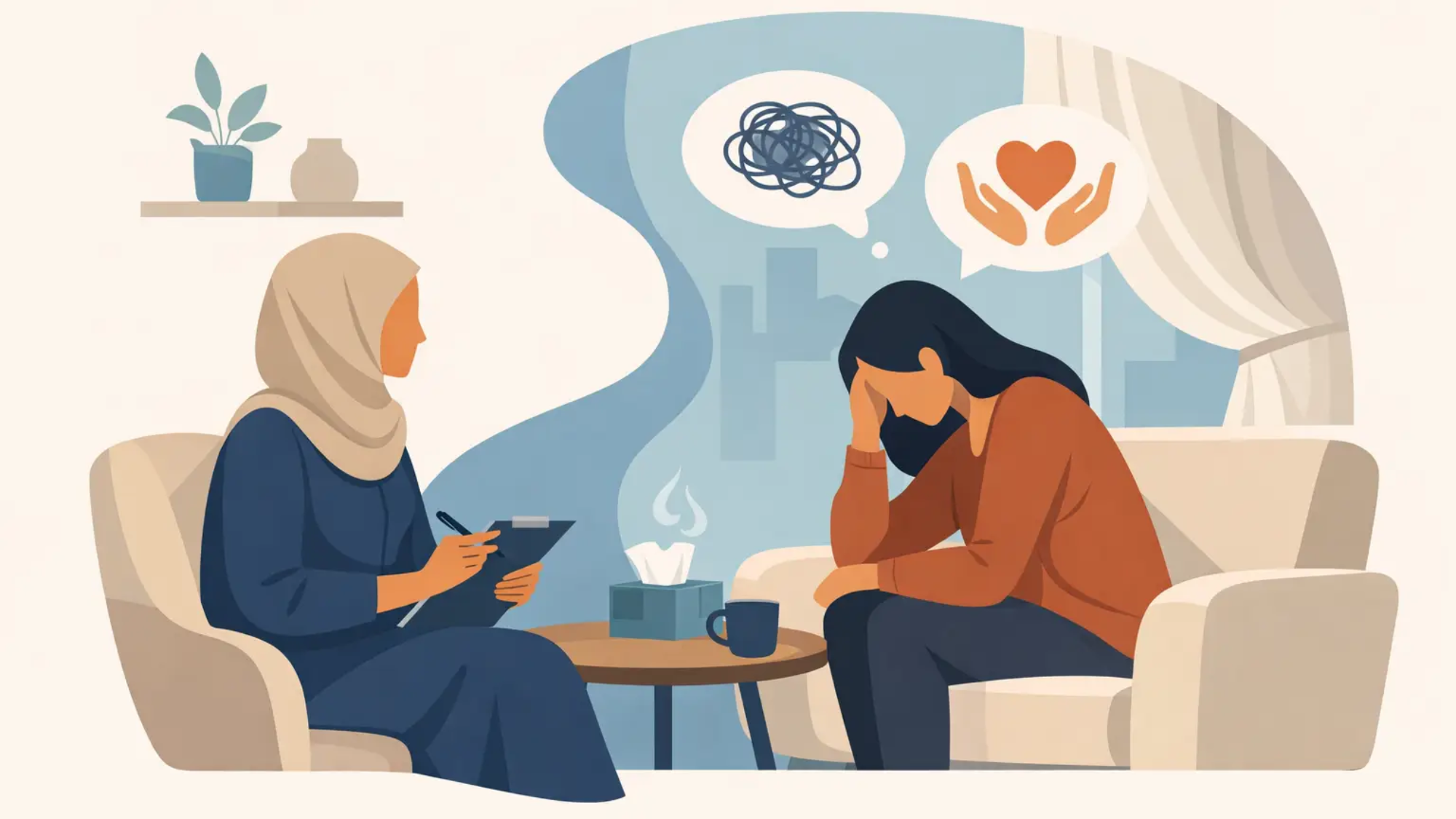
Some forms of depression are loud: tears that will not stop, a body that cannot get out of bed, a mind that keeps saying there is no point. Others are hidden beneath productivity, caretaking, prayer, and a practiced smile. You may still fulfill responsibilities while feeling distant from yourself, from people you love, or even from the sweetness of worship. A Muslim therapist for depression can offer a space where this pain is treated with clinical seriousness and spiritual understanding – without asking you to leave either part of yourself at the door.
Depression is not evidence that your iman is weak, that you are ungrateful, or that you have failed at sabr. It can be a whole-person condition involving the nervous system, thought patterns, grief, trauma, relationships, health, and environment. Faith can be a profound source of meaning and resilience, but it was never meant to become a weapon used against someone who is suffering.
Depression can be real even when you are still functioning
Many Muslim women have learned to endure quietly. They may be carrying family expectations, work demands, marriage stress, parenting responsibilities, isolation, discrimination, or old wounds that were never named. They may tell themselves, “Others have it worse,” then feel ashamed that ordinary tasks require so much effort.
Depression does not always look like staying in bed. It can look like numbness during salah, irritability with children, withdrawing from friends, losing interest in what once mattered, difficulty concentrating, changes in sleep or appetite, or relentless self-criticism. It may also coexist with anxiety, OCD, chronic pain, or trauma. When these concerns overlap, generic encouragement can feel painfully insufficient.
A careful assessment matters because the right treatment depends on what is actually happening. Low mood after a major loss may call for a different therapeutic focus than depression shaped by trauma, perfectionism, intrusive thoughts, burnout, or a longstanding pattern of emotional invalidation. Medication may also be an appropriate part of care for some people and can be discussed with a qualified medical prescriber alongside therapy.
What makes a Muslim therapist for depression different?
The difference is not simply sharing a religious label. A well-trained Muslim therapist understands that Islamic belief and practice may be central to how you make sense of pain, responsibility, hope, modesty, family, and the future. She should also be able to distinguish between sincere religious concern and symptoms that need clinical treatment.
For example, someone experiencing OCD may fear that unwanted thoughts make her sinful or faithless. Someone with depression may worry that struggling to pray consistently means Allah has abandoned her. A religiously fluent therapist does not dismiss these concerns, nor does she reinforce fear with simplistic spiritual explanations. Instead, she can help you understand the psychological process while holding space for the sacred meaning of your relationship with Allah.
This is especially important when harmful messages have been attached to suffering. “Just make more du’a.” “You need to be stronger.” “Depression is because you are too focused on dunya.” Prayer, Qur’an, du’a, community, and remembrance can be deeply sustaining. Yet treatment should not reduce a complex condition to a spiritual checklist. You deserve care that honors the means Allah has made available, including skilled mental health support.
Therapy can hold both science and devotion
Faith-integrated therapy does not replace evidence-based treatment with religious language. It brings them into honest conversation. Your therapist may use approaches such as Cognitive Behavioral Therapy (CBT) to examine depressive thinking patterns, Acceptance and Commitment Therapy (ACT) to build values-guided action, or Internal Family Systems (IFS) to understand protective parts of yourself that developed in response to pain.
When trauma is part of the story, therapies such as EMDR, Written Exposure Therapy (WET), Cognitive Processing Therapy (CPT), or other trauma-informed approaches may help the nervous system and mind process what has remained unresolved. If depression appears alongside OCD, Exposure and Response Prevention (ERP) may be essential. Dialectical Behavior Therapy (DBT) skills can support emotional regulation, self-compassion, and stability when feelings become overwhelming.
The modality is not the whole treatment. The therapeutic relationship matters. So does the pace. You should not be pushed to disclose more than you are ready to explore, and you should not be left in vague reflection without a clear path forward. Good therapy offers both compassion and direction: room to grieve, practical tools to practice between sessions, and a shared understanding of what healing may look like.
For a Muslim woman, that work may include exploring how faith supports recovery without turning worship into another arena for perfectionism. It may involve rebuilding trust in your own perceptions, setting boundaries with dignity, addressing shame, or recognizing that rest is not laziness. It may also mean reconnecting your daily choices to an Aakhirah-focused life story – one shaped by devotion, agency, and mercy rather than fear alone.
Signs it may be time to seek support
You do not need to wait until you are in crisis to speak with a therapist. Therapy can be appropriate when sadness, emptiness, hopelessness, or exhaustion has lasted more than two weeks, especially when it affects sleep, relationships, work, school, appetite, or worship. It can also help when you are functioning outwardly but feel like you are disappearing inwardly.
Seek urgent support right away if you are thinking about harming yourself, feel unable to stay safe, or believe others would be better off without you. In the United States, call or text 988 for the Suicide & Crisis Lifeline, call 911, or go to the nearest emergency room if there is immediate danger. Reaching out in that moment is not a burden to others. It is a protective act for the life Allah entrusted to you.
How to choose the right therapist
Finding a therapist can feel vulnerable, particularly if you have previously felt misunderstood, judged, or given advice that confused cultural pressure with religious obligation. A therapist does not need to have your identical life experience to help you, but she should show humility, clinical competence, and respect for your values.
In an initial consultation, you might ask whether she has experience treating depression alongside trauma, anxiety, OCD, or chronic stress. Ask how she integrates Islamic values into therapy and whether that integration is client-led rather than assumed. If faith is important to you, it is reasonable to want a clinician who can understand concepts such as tawakkul, sabr, waswasa, repentance, family duty, and modesty in their proper context.
Practical fit matters, too. Confirm licensure in the state where you are physically located during online sessions, scheduling availability, fees, and whether her approach feels structured enough for your needs. Manara Counseling provides online psychotherapy for Muslim women in select U.S. states, with care grounded in both advanced clinical treatment and Islamic scholarship.
It is also fair to notice how you feel after a first conversation. Do you feel rushed, minimized, or pressured to perform wellness? Or do you feel respected as a full human being – someone with pain, intelligence, faith, and the capacity to heal? Trust is built over time, but emotional safety should be present from the beginning.
Healing is more than feeling better
Depression often narrows the future until survival is the only goal. Therapy can help widen that view again. At first, progress may be modest: taking a shower, answering one message, eating regularly, naming a feeling instead of suppressing it. Those steps are not small when your system has been carrying more than it can bear.
Over time, healing may involve learning that your worth is not earned through usefulness, achieving a steadier relationship with your thoughts, or making choices from values rather than despair. It may involve mourning what you needed and did not receive. It may involve returning to Allah not as someone who must prove she is worthy of mercy, but as a servant who has always been held by it.
You do not have to explain away your suffering to deserve help. Take one honest step toward care, and let that step become part of the return you are already making.
