
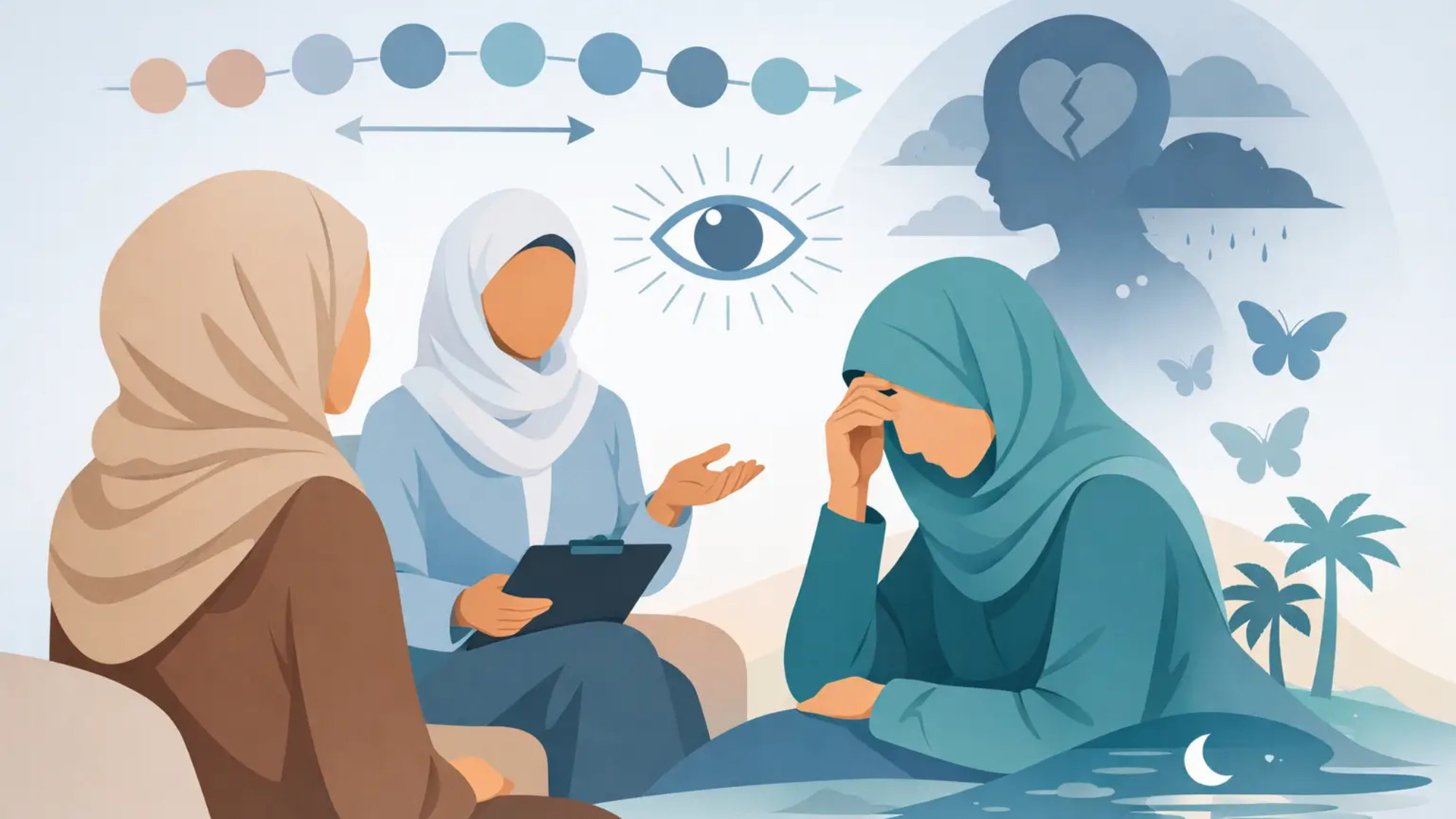
Some memories do not remain in the past simply because time has passed. They may return as a rush of fear during conflict, a tightening in the chest after a familiar phrase, numbness in prayer, or an exhausting need to stay alert when nothing appears immediately wrong. EMDR for Muslim women trauma offers a structured way to help the mind and body process what they have been carrying, without asking a woman to leave her faith at the therapy room door.
For many Muslim women, trauma has also been misunderstood. A painful response may be labeled weakness, ingratitude, a lack of sabr, or insufficient tawakkul. But a nervous system shaped by danger is not a moral failure. It is often doing exactly what it learned to do to survive. Faith can be a profound source of meaning and strength, yet sincere devotion does not make someone immune to the effects of abuse, loss, betrayal, racism, medical trauma, family instability, or chronic emotional harm.
What EMDR Does for Trauma
Eye Movement Desensitization and Reprocessing, or EMDR, is an evidence-based trauma therapy. It helps the brain reprocess memories that remain stored in a distressing, unintegrated way. Rather than requiring a client to give a detailed verbal account of every part of what happened, EMDR works with the memory, the emotions, the body sensations, and the beliefs that became attached to the experience.
A traumatic event can leave behind conclusions such as, “I am not safe,” “It was my fault,” “I am powerless,” or “I am unworthy of care.” Even when a woman intellectually knows these statements are not true, her body may still react as if the danger is present. EMDR aims to reduce the intensity of that alarm and help the memory become something that happened, rather than something that continues to happen internally.
During EMDR, bilateral stimulation is used to support this reprocessing. This may involve following side-to-side movements with the eyes, alternating sounds, or gentle alternating taps. The clinician guides the pace carefully, checking in often and helping the client remain anchored in the present.
The goal is not to erase memory or force forgiveness. It is to help the memory lose its hold. A client may remember what occurred while no longer being overwhelmed by the terror, shame, helplessness, or self-blame tied to it.
EMDR for Muslim Women Trauma With Faithful Care
For a Muslim woman, healing is often connected to more than symptom relief. She may be asking how to feel safe in her body again, how to pray without being pulled into panic or intrusive memories, how to trust her judgment, or how to hold grief while remaining connected to Allah. These are not peripheral concerns. They belong in the therapeutic work when they matter to the client.
Faith-integrated EMDR does not turn therapy into a lecture or use religious language to rush someone through pain. It also does not assume that every spiritual struggle is a clinical problem. Instead, it makes room for the reality that deen can be a source of grounding, identity, values, and hope.
For one client, a session may draw on the comfort of Allah’s names or a verse that genuinely brings steadiness. For another, treatment may include tenderly addressing religious guilt, fear of disappointing Allah, or spiritual practices that have become entangled with trauma. A skilled Muslim clinician can distinguish between healthy religious conviction and trauma-driven fear, perfectionism, or waswasa.
This matters because religious language can either support healing or unintentionally deepen shame. Telling a traumatized woman to “just make dua” may overlook the treatment she needs. At the same time, treating her faith as irrelevant may overlook one of the most meaningful sources of resilience in her life. She does not have to choose between sound clinical care and devotion to Allah.
Trauma Does Not Always Look Like One Catastrophic Event
Some women come to EMDR after a clearly identifiable event, such as assault, an accident, childbirth complications, a sudden loss, or witnessing violence. Others carry the impact of repeated experiences: criticism in the home, coercive control, emotional neglect, community rejection, discrimination, or years of living with unpredictability.
Complex trauma can be especially confusing because there may be no single memory that seems “bad enough” to deserve care. Yet the effects can be significant. A woman may people-please compulsively, freeze during disagreement, distrust kind people, struggle to rest, or feel intense shame when she has needs. EMDR can be part of treatment for these patterns, though the work may require more preparation and a slower pace than treatment for a single event.
What an EMDR Session May Feel Like
EMDR is not a one-size-fits-all process. Before reprocessing begins, a trauma-informed therapist assesses symptoms, history, current stressors, coping resources, and readiness. This phase is essential. If someone is living in active danger, severely dissociated, in crisis, or unable to regulate between sessions, the immediate work may focus on safety, stabilization, and practical support first.
Preparation often includes learning ways to return to the present when emotion rises. A therapist may help a client identify calming imagery, strengthen self-compassion, practice noticing body cues, and build a sense of internal and external safety. For a Muslim woman, this might include faith-based grounding if she wishes, alongside clinical tools such as paced breathing, sensory orientation, and emotion-regulation skills.
When reprocessing begins, the client identifies a target memory and notices the image, negative belief, emotion, and body sensation connected to it. She does not have to perform strength, explain perfectly, or produce a dramatic emotional response. Her task is simply to notice what arises while the therapist helps her stay within a manageable window of tolerance.
Sessions can feel relieving, tiring, surprising, or emotionally tender. New connections may emerge between past experiences and present patterns. Some clients notice distress easing quickly. Others need more time, particularly when trauma is layered, longstanding, or connected to ongoing relational wounds. Progress is not measured by never feeling pain again. It can look like being able to set a boundary without collapsing into guilt, sleeping more peacefully, or responding to a trigger with choice rather than automatic survival.
When EMDR May Need Additional Support
EMDR is a powerful modality, but it is not the only useful treatment for trauma. A comprehensive approach may also include cognitive behavioral therapy, acceptance and commitment therapy, internal family systems-informed work, somatic grounding, or skills drawn from dialectical behavior therapy. The best approach depends on the person, the type of trauma, and what is happening in her life now.
For example, a woman with OCD may need exposure and response prevention to address compulsions, including religious OCD or waswasa. A woman experiencing an abusive relationship may need safety planning and advocacy before trauma processing. A woman with chronic pain may benefit from treatment that addresses both nervous-system sensitization and the practical realities of her medical care.
Thoughtful therapy does not apply EMDR simply because it is popular. It asks: What is this client carrying? What will help her feel safer? What treatment is clinically appropriate now? And how can we honor the whole person, including her body, relationships, mind, and faith?
Choosing a Therapist Who Understands the Whole Story
Trauma requires more than a therapist who knows a protocol. It requires emotional safety, clear boundaries, informed consent, and a relationship in which a client does not need to translate her entire world before she can be understood.
A Muslim woman seeking EMDR may want to ask whether a therapist has formal EMDR training, experience with trauma and dissociation, and a plan for stabilization if intense feelings arise. She may also ask how the therapist approaches Islamic values, family dynamics, modesty, spiritual concerns, and religious OCD. The answer should feel respectful and clinically grounded, not performative.
At Manara Counseling, faith-integrated care is designed to hold both realities: the mind may need evidence-based treatment, and the soul may long for a return to Allah that is gentler, steadier, and free from shame.
You were not created to remain defined by what wounded you. Healing may be gradual, and it may ask for patience, support, and courage. But each honest step toward safety can become part of a life that is not merely organized around surviving, but rooted in dignity, mercy, and sacred purpose.
