
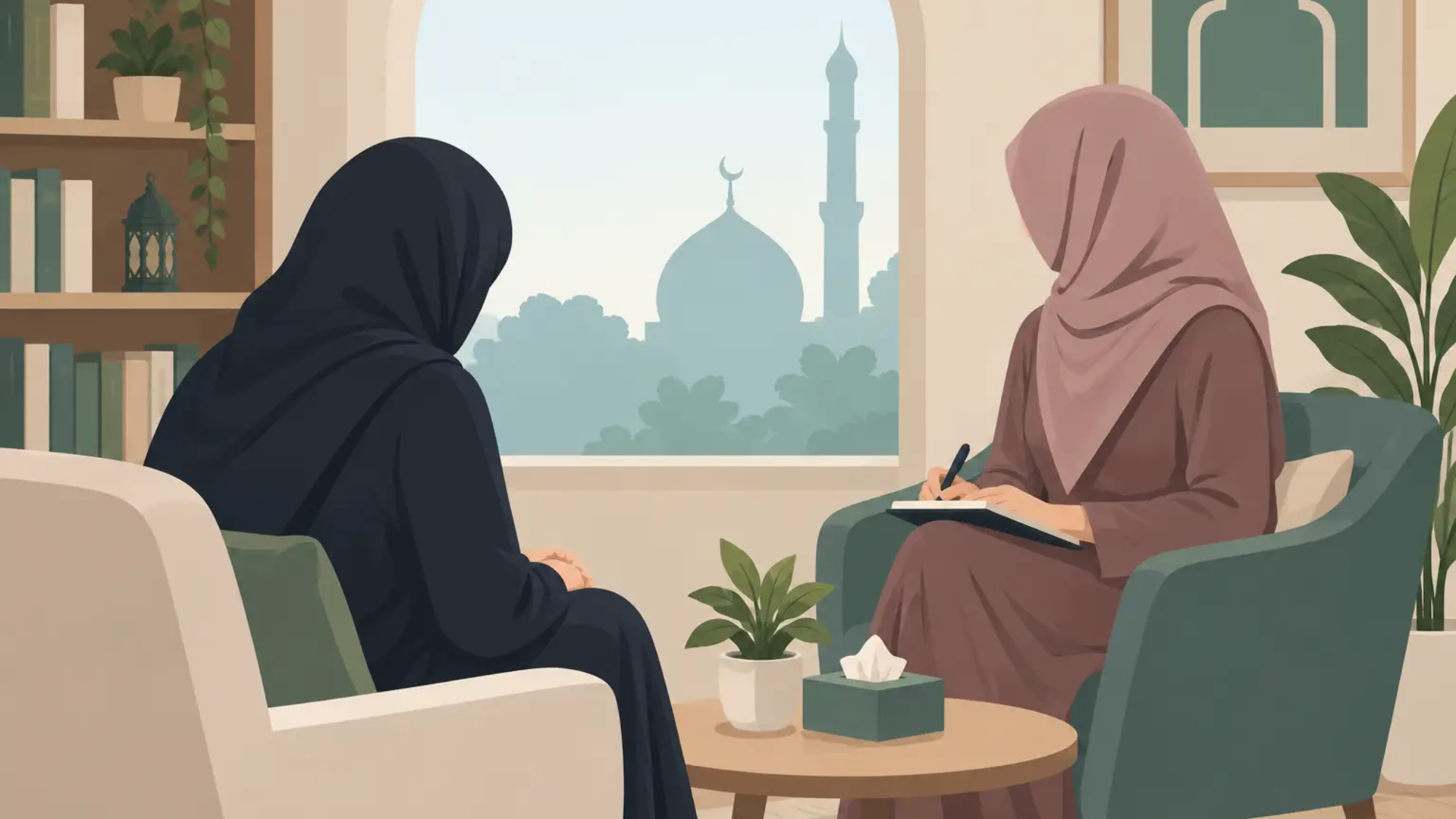
A Muslim woman may sit on her prayer mat after Fajr, asking Allah for relief, and still feel her chest tighten before the day has even begun. She may know the verses about mercy, make du’a sincerely, and yet continue to live with panic, intrusive thoughts, a trauma response, or a sadness she cannot simply will away. So, can Muslim women use therapy? Yes. Seeking skilled care for emotional and psychological suffering can be part of honoring the life, mind, and heart Allah has entrusted to you.
Therapy is not a declaration that faith has failed. It can be a form of taking the means while placing the outcome with Allah. For many Muslim women, the deeper question is not whether help is allowed. It is whether they can receive help without having to set aside their modesty, values, family context, or devotion. They should not have to.
Can Muslim Women Use Therapy Without Compromising Faith?
Islam does not ask us to deny pain in order to prove trust in Allah. In the Islamic tradition, seeking treatment is a recognized part of responding to hardship. We take medicine when the body is ill, consult experts when a problem exceeds our knowledge, and turn to Allah throughout it all. Mental health care belongs within that same ethic of responsible, faithful action.
This does not mean every therapist, method, or therapeutic message will feel aligned with a Muslim client’s worldview. Therapy can become uncomfortable when it dismisses religious commitment as pathology, assumes independence must come before family responsibility, or treats every moral concern as shame that needs to be discarded. A thoughtful Muslim woman is right to pay attention to those tensions.
But the answer is not to endure alone. It is to seek care that can distinguish between healthy religious practice and clinical distress, between sincere repentance and obsessive guilt, and between a difficult family dynamic and an obligation to tolerate harm.
Faith-integrated therapy makes room for both realities: you are a servant of Allah with a sacred purpose, and you are a human being whose nervous system, history, relationships, and health affect how you cope.
Therapy Is Not the Opposite of Tawakkul
Tawakkul is often misunderstood as passive waiting. In practice, trust in Allah includes taking wise action while recognizing that healing ultimately comes from Him. A woman with diabetes may make du’a and follow a medical plan. A woman experiencing depression, trauma symptoms, or OCD can make du’a and work with a qualified therapist.
Prayer, Qur’an, dhikr, fasting, community, and charity can be profound sources of grounding and meaning. They may strengthen a person’s capacity to tolerate distress, reconnect her to hope, and remind her that hardship is not evidence of abandonment by Allah. Yet spiritual practices are not meant to be used as a reason to ignore serious symptoms.
If someone has been told, “You just need more sabr,” she may start to feel guilty for struggling. If her intrusive thoughts persist despite constant reassurance and repeated repentance, she may fear that she is spiritually corrupt. If trauma leaves her startled, numb, exhausted, or unable to sleep, she may judge herself for not being grateful enough.
These responses add shame to suffering. Sabr is not silent self-erasure. It can include the brave, disciplined choice to seek support, learn new skills, and face what has been too painful to carry alone.
When Spiritual Struggle May Also Need Clinical Care
Not every difficult emotion requires therapy. Grief, disappointment, fear, and stress are part of a meaningful human life. But therapy may be especially helpful when distress is persistent, interfering with daily functioning, or shaping choices in ways that feel increasingly narrow and painful.
For example, waswasa and OCD can look similar on the surface because both may involve religious concerns. The difference matters. Healthy conscience may invite a person toward sincere correction and then allow her to move forward. OCD often demands certainty that cannot be achieved. It may pull a woman into repeated wudu, compulsive checking, endless research, repeated confessions, or prayers restarted again and again because they do not feel perfect.
In those cases, more reassurance is not always the answer. Exposure and Response Prevention, or ERP, is an evidence-based OCD treatment that helps a person resist compulsions and learn that uncertainty can be tolerated. When clinically appropriate, it can be practiced with sensitivity to Islamic obligations rather than against them.
The same is true for trauma. A woman may intellectually know she is safe while her body continues to react as though danger is near. Trauma-focused approaches such as EMDR, Cognitive Processing Therapy, Written Exposure Therapy, and Internal Family Systems-informed work can help process what the nervous system has stored. This is not about forcing yourself to relive every detail. Good trauma therapy is paced, collaborative, and attentive to safety.
Anxiety, depression, chronic pain, relationship strain, and perfectionism may benefit from approaches such as CBT, ACT, and DBT. The best fit depends on your symptoms, history, goals, and readiness. Therapy is not one generic conversation. It is a structured process that should be tailored to the person sitting in the room, or meeting securely online.
What Faith-Integrated Therapy Can Offer Muslim Women
A clinically trained Muslim therapist does not need to turn every session into a religious lecture. Nor should therapy use Islam as a shortcut around grief, anger, or fear. Instead, faith can serve as an honest part of the therapeutic context.
That might mean recognizing that modesty matters when discussing your body, that family ties carry real spiritual weight, or that your relationship with Allah is a source of resilience rather than a symptom to analyze away. It can mean helping you set boundaries without making you feel that boundaries require abandoning compassion. It can mean addressing scrupulosity without feeding compulsions or minimizing the seriousness of worship.
It may also mean naming a truth that many Muslim women need to hear: being dutiful does not require accepting mistreatment. Being forgiving does not require immediate access to someone who has harmed you. Being grateful does not mean pretending you are not in pain.
At the same time, faith-integrated care should retain clinical rigor. A therapist should assess symptoms carefully, use evidence-based treatment, respect confidentiality and professional ethics, and know when a higher level of care or medication evaluation may be needed. Religious fluency is valuable, but it is not a substitute for competence.
How to Choose a Therapist Who Feels Safe and Skilled
You do not need to share every belief with a therapist for therapy to help. But you do deserve to ask whether a clinician can work respectfully with your faith. An initial consultation can help you understand their approach.
You might ask whether they have experience with trauma, OCD, anxiety, or the concern bringing you in. You can ask how they distinguish religious practice from compulsive behavior, whether they are comfortable discussing Islamic values, and how they approach family and cultural dynamics. If you prefer a female therapist, it is reasonable to prioritize that preference.
Pay attention to how you feel after the conversation. You do not need instant emotional comfort, especially if you are discussing painful material. But you should feel respected, heard, and free to ask questions. A good therapeutic relationship has room for honesty, including moments when a recommendation does not feel consistent with your values.
There are practical considerations too. Verify that the therapist is licensed in the state where you are physically located during online sessions. Ask about cost, insurance or out-of-network options, scheduling, and the type of therapy offered. Access matters, and the right therapy must also be workable within your real life.
A Rooted Way Forward
Healing rarely looks like becoming untouched by pain. More often, it looks like becoming less ruled by it. It looks like sleeping more peacefully, praying without compulsive fear, speaking to yourself with greater mercy, setting a boundary without drowning in guilt, and making choices from values rather than survival.
For the Muslim woman who has carried too much in silence, therapy can be a place to tell the truth with dignity. It can help you understand your patterns, tend to wounds that were never given language, and build a life that is psychologically steadier and spiritually rooted.
You do not have to choose between serious mental health care and sincere devotion to Allah. Seeking support may be one of the ways you return to yourself with honesty, and return to Allah with greater trust.
