
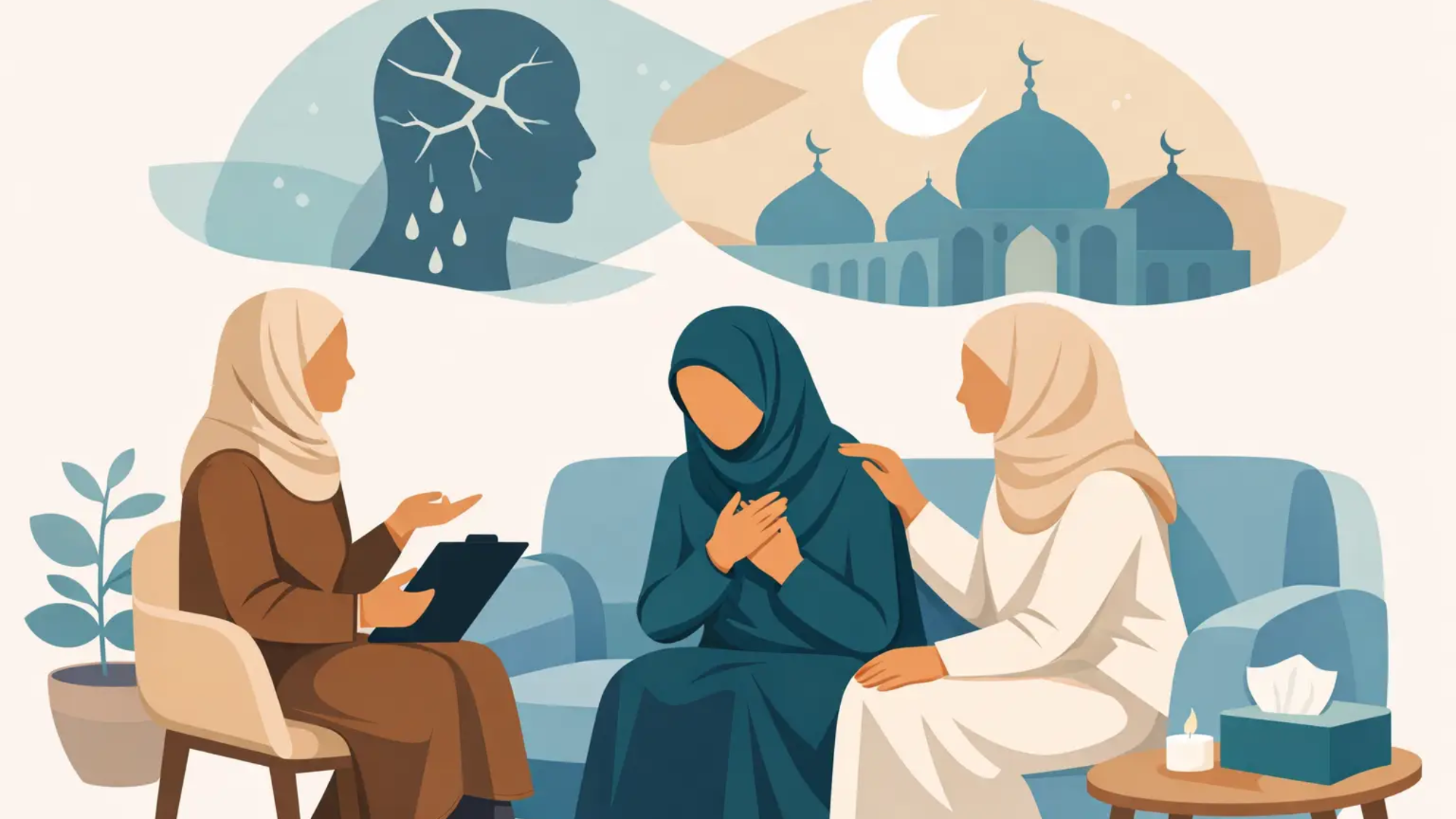
A woman may carry trauma quietly for years while appearing deeply capable. She may pray, care for others, work, parent, study, and meet every expectation placed before her. Yet her body may still brace at a raised voice, her mind may replay what happened, or her heart may feel distant from the peace she longs for. Trauma informed therapy for Muslim women makes room for the whole truth: your suffering deserves skilled care, and your faith can be a source of grounding without becoming another burden you must perform.
Trauma is not a sign that you are weak in iman. It is not proof that you failed to be patient enough. It is what can happen when an experience overwhelms the nervous system’s ability to cope, process, and return to safety. Healing asks for compassion, clinical precision, and a space where your Islamic values are understood rather than treated as an obstacle.
What Trauma Can Look Like Beyond the Event
Trauma is often associated with a single catastrophic event, such as an assault, accident, or sudden loss. Those experiences can certainly be traumatic. But many Muslim women also live with the effects of chronic, repeated wounds: emotional neglect, coercive control, family conflict, bullying, racism, religious discrimination, painful medical experiences, betrayal, or growing up in a home where anger and unpredictability shaped daily life.
The body does not only remember what happened. It also remembers what it had to do to survive. You may become highly alert to other people’s moods, find it difficult to say no, go numb during conflict, overexplain yourself, or feel guilty whenever you rest. Some women experience panic, insomnia, intrusive memories, depression, dissociation, chronic pain, or a persistent sense that something bad is about to happen.
These responses were not chosen. They are protective adaptations. A trauma-informed therapist does not ask, “Why are you overreacting?” She asks, “What has your system learned it needs to do to keep you safe?” That shift matters. It replaces shame with curiosity and gives treatment a clear direction.
What Trauma-Informed Therapy for Muslim Women Offers
Trauma-informed care begins with safety. This does not mean therapy will avoid painful material forever. It means that healing will not require you to relive your story before you have the support and skills to stay present with it.
A clinician may first help you understand your nervous system, notice the signals of overwhelm, and practice ways to come back to the present. This can include grounding, emotional regulation, work with boundaries, and identifying the situations that pull you into fight, flight, freeze, fawn, or shutdown. For some women, building this foundation is a brief phase. For others, especially after complex or developmental trauma, it takes longer. There is no moral failure in needing time.
From there, treatment may include evidence-based approaches such as EMDR, Cognitive Processing Therapy, Written Exposure Therapy, Internal Family Systems, Acceptance and Commitment Therapy, or Dialectical Behavior Therapy. The right approach depends on your symptoms, history, goals, readiness, and practical circumstances. EMDR, for example, can help the brain reprocess distressing memories. CPT may be useful when trauma has left behind painful beliefs such as “It was my fault” or “I cannot trust anyone.” DBT skills can be especially helpful when emotions feel intense, relationships feel unstable, or distress leads to impulsive coping.
Good therapy is not a one-size-fits-all protocol. It is a collaborative process that respects both the science of treatment and the person receiving it.
Faith Is Neither Dismissed Nor Used to Bypass Pain
Many Muslim women have been given well-intended but incomplete responses to suffering: make more du’a, be grateful, have sabr, do not dwell on the past. Prayer, Qur’an, dhikr, and du’a can be profound sources of comfort and strength. They may also be part of a meaningful healing plan.
But faith should not be used to silence legitimate pain. Sabr is not passive endurance of harm. Tawakkul does not mean abandoning wise action. And forgiveness, where it is even appropriate, does not require restored access, erased boundaries, or denial of what occurred.
A faith-integrated therapist can honor the spiritual language that matters to you while maintaining clinical clarity. She can help you distinguish between healthy religious devotion and trauma-driven perfectionism. She can recognize when intrusive thoughts may reflect OCD or waswasa rather than a spiritual defect. She can support you in bringing your relationship with Allah into healing without turning every symptom into a religious problem.
Why Cultural and Religious Fluency Changes the Room
Therapy is most effective when a client does not have to spend half the session translating her life. For a Muslim woman, that may include explaining why modesty matters, why family ties feel morally weighty, why marriage concerns cannot be separated from faith, or why a particular religious fear feels so frightening.
Cultural and religious fluency does not mean a therapist assumes every Muslim family, ethnicity, or community experience is the same. It means she knows enough to ask better questions. She understands that family can be a place of love and obligation, as well as pain. She can make room for the real complexity of community expectations, immigration stories, intergenerational patterns, and identity without stereotyping you.
This is especially important when trauma involves someone close to you. You may fear being judged for naming mistreatment by a parent, spouse, elder, or respected community member. You may worry that seeking help is disloyal or that protecting yourself means abandoning your duties. A skilled therapist will not pressure you toward estrangement or reconciliation. Instead, she will help you assess safety, clarify your values, and make decisions with greater freedom rather than fear.
Signs You May Benefit From Support
You do not need to be in crisis to seek trauma therapy. Support may be appropriate when the past continues to shape your present in ways you do not want. Perhaps you avoid certain places or conversations, feel trapped in people-pleasing, struggle to feel close to others, or become overwhelmed by seemingly small moments.
It may also be time to seek care if you have tried to “move on” but your body has not followed. Trauma can persist even when you intellectually understand that an event is over. Knowing you are safe and feeling safe are not always the same thing.
If you are currently in danger, experiencing abuse, or having thoughts of harming yourself, immediate safety comes first. Reach out to local emergency services, a crisis resource, or a trusted person who can help you create a concrete plan. Therapy can be part of longer-term support, but it should never replace urgent protection.
What a First Session May Feel Like
Beginning therapy can feel vulnerable, particularly if you have been dismissed before. You are allowed to ask questions about a therapist’s approach, training, faith integration, confidentiality practices, and experience with your concerns. You are also allowed to notice whether you feel respected.
The first appointment is usually not a demand to disclose every detail. It is a conversation about what brings you in, what you hope will change, and what safety looks like for you. You may discuss current symptoms, important history, supports, spiritual practices, and any concerns about treatment. Together, you and your therapist can begin to create a plan that is structured enough to feel purposeful and flexible enough to honor your pace.
Healing may include grief. It may bring anger, tenderness, relief, and new boundaries that feel unfamiliar at first. It can also make room for a quieter kind of strength: the ability to be with yourself without abandoning yourself.
Your story is not reduced to what was done to you. With compassionate, clinically grounded care, you can learn to respond to the past without being ruled by it, turn toward Allah with greater honesty, and build a life that feels safer to inhabit.
