
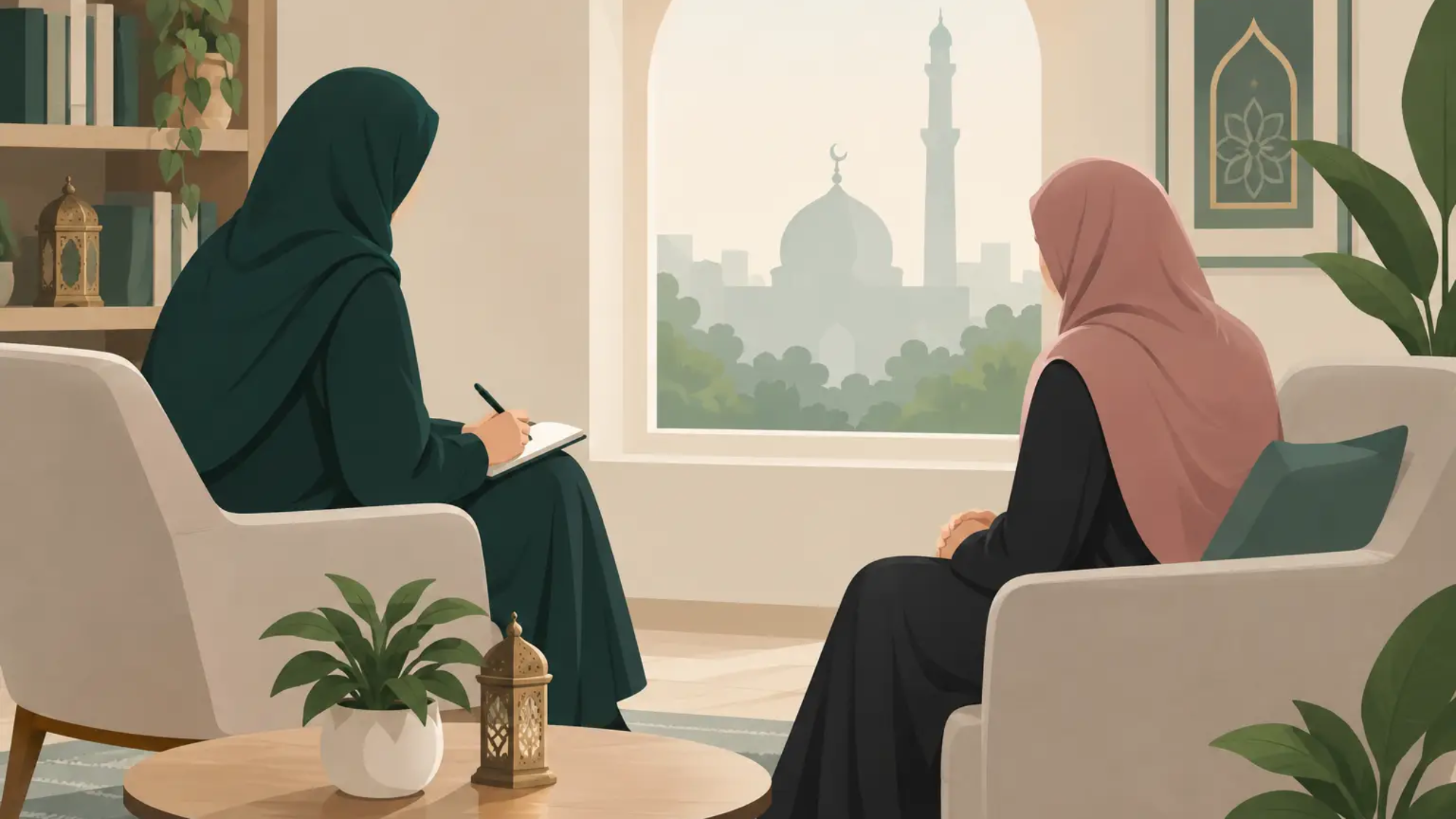
A Muslim woman can know that Allah is near and still feel her body tighten before sleep. She can pray, make dhikr, show up for her family, and still be haunted by intrusive thoughts, grief, panic, or memories that do not seem to loosen their hold. Islamically grounded psychotherapy makes room for this full reality. It does not ask you to set aside your faith in order to receive serious mental health care, nor does it reduce profound suffering to a reminder to simply have more sabr.
For many women, the pain is not only the symptom itself. It is the fear that needing help says something about their iman. It is the exhaustion of explaining waswasa to someone who does not understand why a thought can feel spiritually terrifying. It is being told to make du’a when what is also needed is careful assessment, trauma-informed treatment, and a clinician who understands the difference between a spiritual struggle and a nervous system in distress.
What Islamically Grounded Psychotherapy Means
Islamically grounded psychotherapy is clinically rigorous therapy shaped by an Islamic worldview. It brings together evidence-based treatment and religious fluency so that healing can be understood in a way that honors both the mind and the soul.
This is not therapy with a few Islamic phrases added at the edges. Faith can inform the therapeutic frame itself: how a client understands human dignity, accountability, hope, suffering, relationships, purpose, and return to Allah. The Quranic understanding that every soul is honored can stand beside a careful clinical understanding of trauma responses, depression, compulsions, attachment wounds, and chronic stress.
At the same time, Islamic integration should never be used to bypass emotional pain. A therapist should not treat anxiety as a failure of tawakkul or depression as proof of weak gratitude. Spiritual practices can be deeply sustaining, but they are not a substitute for a thoughtful treatment plan when someone is living with OCD, PTSD, major depression, or debilitating panic.
The work is both compassionate and honest. A client may be invited to notice the mercy already present in her life while also learning how avoidance keeps fear alive. She may reflect on reliance upon Allah while practicing skills that help her regulate an overwhelmed nervous system. These are not competing paths. They can support one another.
Why Faith Integration Changes the Therapy Room
A therapeutic relationship becomes safer when a woman does not have to translate the most sacred parts of herself. She should not have to explain why prayer matters, why modesty affects her choices, or why certain family and community dynamics carry particular weight. Being understood does not mean every assumption about Muslim women is made for her. It means her individual story is received with cultural humility and religious literacy.
This matters especially when symptoms involve faith. OCD can attach itself to wudu, salah, purity, blasphemous intrusive thoughts, or fears of having committed shirk. In these moments, reassurance alone often strengthens the OCD cycle. Effective care may include Exposure and Response Prevention, or ERP, which helps a client face uncertainty without repeating compulsions or seeking constant certainty.
An Islamically informed clinician can hold a crucial distinction: an unwanted intrusive thought is not the same as a chosen belief, intention, or sin. Treatment can respect religious obligations without allowing OCD to turn those obligations into a source of torment. The goal is not to make faith less meaningful. It is to help the client worship with greater freedom rather than fear.
Trauma requires similar care. A survivor may carry shame, numbness, hypervigilance, or a fractured sense of safety while also wrestling with questions about qadr, justice, forgiveness, and trust. There are no simplistic answers for sacred questions born from harm. Therapy can provide a protected space to grieve what happened, restore a sense of agency, and build a life that is not organized around the injury.
Treatment That Meets the Whole Person
Good faith-integrated therapy begins with a thorough understanding of what is happening now. Symptoms may overlap. A woman who calls herself lazy may be living with depression, burnout, chronic pain, trauma-related shutdown, or untreated ADHD. Someone who believes she is overly emotional may be responding normally to years of invalidation or instability.
From there, treatment is selected based on clinical need, not trend. Cognitive Behavioral Therapy can help identify patterns between thoughts, emotions, and behavior. Acceptance and Commitment Therapy can support values-based action even when difficult feelings are present. Dialectical Behavior Therapy offers concrete skills for emotional regulation, distress tolerance, and relationships.
For trauma, approaches such as EMDR, Written Exposure Therapy, Cognitive Processing Therapy, and Internal Family Systems-informed work may be appropriate depending on the client’s history, stability, preferences, and treatment goals. No single modality is right for every person. Some women need direct trauma processing; others first need sleep, safety, boundaries, or stabilization before approaching painful memories.
A clinically grounded therapist also pays attention to the body. Trauma and anxiety are not only experienced as thoughts. They may show up as headaches, stomach pain, fatigue, insomnia, muscle tension, dissociation, or a constant sense of being on guard. Learning to recognize these signals can help a client respond with care instead of self-criticism.
Spiritual grounding is not spiritual pressure
Faith can be a source of immense strength, but it should not become another standard a suffering woman feels she is failing to meet. In therapy, a client might choose to explore du’a, Quranic reflection, tawakkul, repentance, gratitude, or Islamic teachings about mercy. She may also choose to focus primarily on clinical tools during a difficult season. Collaboration matters.
The therapist’s role is not to dictate a client’s religious practice or issue religious rulings. It is to help her make sense of her internal world and pursue healing in a manner congruent with her beliefs. When a question requires specialized religious guidance, a thoughtful clinician can acknowledge the boundary rather than speak beyond her role.
This is particularly important for women who have experienced religious messages as harsh, shaming, or controlling. Islamically grounded care does not weaponize accountability. It recognizes that accountability is meaningful when it is held within Allah’s mercy, human limitation, and the client’s God-given capacity to repair and grow.
What Progress Can Look Like
Progress is not always dramatic. Sometimes it is a woman realizing that she can feel anxious without obeying anxiety. It is completing salah without repeating it for an hour. It is setting a boundary without collapsing into guilt. It is sleeping through the night after years of hypervigilance, or recognizing that a painful memory belongs to the past rather than the present.
There may also be spiritual shifts: a more merciful inner voice, a less fearful relationship to Allah, greater honesty in du’a, or a renewed ability to imagine an Aakhirah-focused life that is not defined by pain. These shifts are not measured by outward perfection. They are often reflected in increased flexibility, steadiness, connection, and willingness to keep moving toward what matters.
Healing rarely follows a straight line. Symptoms may intensify briefly as avoidance decreases or as trauma work brings buried material into awareness. A skilled therapist prepares clients for these possibilities, monitors safety, and adjusts the pace. Treatment should be challenging enough to create change, yet paced carefully enough that the client remains supported.
Choosing Care That Honors Your Needs
If you are seeking a Muslim therapist, it can help to ask direct questions. Does the clinician have experience with your concern, whether it is trauma, OCD, depression, anxiety, or chronic pain? Can she explain the treatment approaches she uses and why they may fit? Does she understand Islamic concepts without assuming your faith journey looks exactly like someone else’s?
Also consider how you feel in the consultation. You deserve a clinician who can hold both tenderness and clarity, who does not minimize what you carry, and who sees you as more than a collection of symptoms. At Manara Counseling, this standard means pairing religiously fluent care with evidence-based treatment for Muslim women who are ready to be met in the fullness of their story.
You do not need to earn care by becoming less affected, more articulate, or more spiritually polished first. You can come as you are: tired, faithful, uncertain, grieving, hopeful, or all of these at once. Seeking help can be one quiet, courageous way of honoring the amanah of your own heart.
