
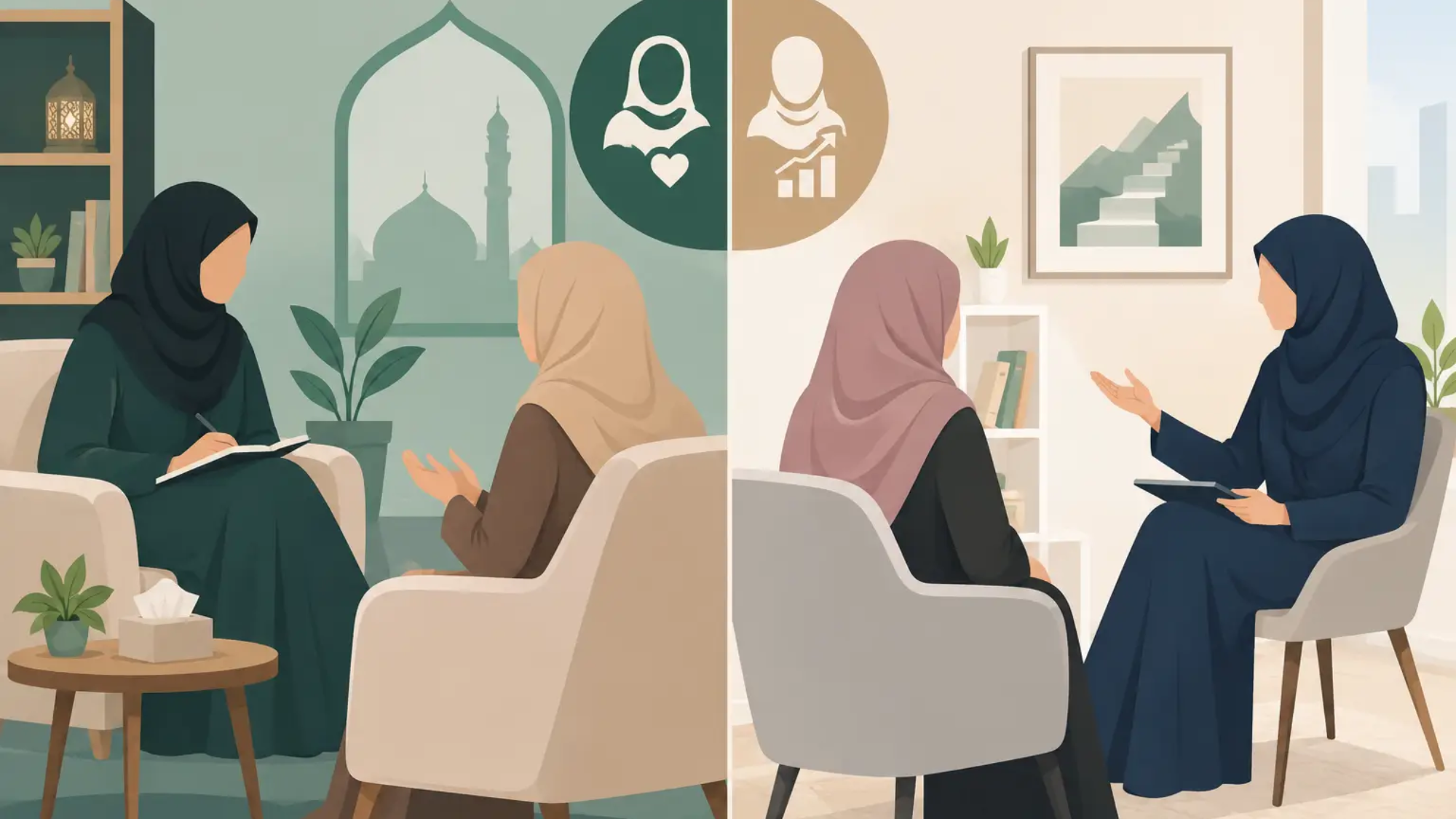
You may have been told that you simply need more discipline, a better routine, or stronger tawakkul. Yet beneath the difficulty may be panic that wakes you before Fajr, intrusive thoughts that make worship feel frightening, or a body that remains braced for pain long after the danger has passed. The question of a Muslim therapist vs life coach is not about which form of support is more faithful. It is about choosing support that can hold the true weight of what you are carrying.
A wise coach can help you move toward a meaningful goal. A qualified Muslim therapist can help you understand and treat mental health symptoms, trauma responses, relational wounds, and patterns that may be interfering with your ability to live, worship, and rest. For many Muslim women, the most compassionate choice begins with refusing the false divide between clinical care and devotion to Allah.
Muslim Therapist vs Life Coach: The Core Difference
The central difference is scope. A licensed therapist is a regulated mental health professional who has completed graduate clinical training, supervised practice, licensing examinations, and continuing education requirements. Therapists assess mental health concerns, provide psychotherapy, maintain clinical documentation, and work within ethical and legal standards set by their state licensing boards.
A life coach typically helps clients clarify goals, build accountability, identify obstacles, and create action plans. Coaching may be useful for areas such as career direction, habits, leadership, time management, or a transition that does not involve a clinical mental health condition. Training and credentials vary widely in coaching. Unlike psychotherapy, coaching is generally not designed to diagnose or treat anxiety disorders, depression, OCD, PTSD, or other mental health conditions.
This distinction matters because suffering is not always a motivation problem. A woman who cannot begin a task may be experiencing depression, executive dysfunction, burnout, trauma-related avoidance, or perfectionism shaped by fear. Someone who continually seeks reassurance about wudu or salah may not need another productivity system. She may need assessment and treatment for OCD, including exposure and response prevention (ERP).
A Muslim therapist does not view faith as an obstacle to care or an optional cultural detail. When appropriately trained, she can understand that salah, du’a, modesty, family obligations, repentance, and hope in Allah may be central to a client’s values and healing. At the same time, religious language should never be used to minimize symptoms that deserve skilled treatment.
When Therapy Is the Better Starting Point
Therapy is often the better place to begin when your distress feels persistent, intense, confusing, or disruptive to daily life. This includes difficulty sleeping, appetite changes, frequent crying, panic, numbness, persistent guilt, anger that feels hard to control, isolation, or a loss of interest in what once mattered to you.
It is also appropriate to seek therapy when the past continues to live in the present. Trauma can appear as hypervigilance, people-pleasing, dissociation, chronic pain, shutdown, nightmares, or feeling unsafe even in loving relationships. You do not need to prove that your experience was “bad enough” before receiving care. If your nervous system learned to survive by staying on alert, healing may require more than insight or encouragement.
Certain concerns require specialized clinical attention. Intrusive thoughts involving faith, purity, harm, or sexuality can be especially painful for Muslims because they may be mistaken for a spiritual or moral failure. In OCD, a thought is not an intention, a desire, or evidence of weak iman. Reassurance, repeated checking, compulsive repentance, and avoidance can temporarily lower anxiety while strengthening the cycle over time. Evidence-based approaches such as ERP and acceptance and commitment therapy (ACT) can help loosen that cycle without asking you to abandon your religious commitments.
Similarly, depression is not cured by being reminded to be grateful, and trauma is not resolved by being told to have sabr. Sabr is not passive endurance of untreated pain. It can include the brave, deliberate decision to pursue treatment, learn new skills, tell the truth about what hurts, and trust that seeking means is part of reliance upon Allah.
A therapist may use approaches such as cognitive behavioral therapy (CBT), dialectical behavior therapy (DBT), internal family systems (IFS), cognitive processing therapy (CPT), written exposure therapy (WET), or EMDR, depending on your needs and clinical history. Good treatment is not a collection of trendy methods. It is a thoughtful plan shaped by careful assessment, your goals, your safety, and your response to the work.
Faith Integration Is More Than Familiar Vocabulary
Not every therapist who shares your background will be the right fit, and not every Muslim therapist offers the same level of religious fluency or clinical specialization. It is reasonable to ask how a clinician integrates faith, what conditions they treat, and whether they have experience with concerns like trauma, OCD, chronic pain, or intense anxiety.
Meaningful faith integration does not mean every session becomes a lesson in religious rulings. Nor does it mean a therapist replaces a scholar, imam, physician, or psychiatrist. Rather, it means therapy honors the moral and spiritual world in which you make decisions. Your treatment can make room for your relationship with Allah, your desire to fulfill obligations, your questions about guilt and mercy, and the particular pressures you may carry as a Muslim woman.
At Manara Counseling, this integration is held alongside clinically rigorous psychotherapy, not in place of it. The aim is not merely to reduce symptoms, though relief matters deeply. It is to help you build a steadier inner life that supports an Aakhirah-focused story.
When a Life Coach May Be a Good Fit
Coaching can be valuable when you are generally emotionally stable and want structured support around a clear, forward-looking objective. Perhaps you are deciding whether to change careers, trying to establish a sustainable routine, preparing for a major life transition, or seeking accountability for goals you have already identified.
The right coach can offer perspective, encouragement, and momentum. For some women, coaching after therapy can be especially helpful: therapy has addressed the anxiety, trauma, or self-criticism that made movement feel impossible, and coaching supports practical follow-through in a new season.
Still, coaching becomes a poor substitute for therapy when sessions repeatedly uncover panic, trauma memories, compulsive behaviors, suicidal thoughts, self-harm, abuse, severe relationship conflict, or an inability to function. An ethical coach should recognize when a client needs referral to a licensed mental health professional. Coaching is not lesser support, but it is different support, and the boundary protects you.
Questions to Ask Before You Choose
Before booking with either provider, listen to both your symptoms and your hopes. If you are unsure, begin by asking whether the provider can explain their scope clearly. A therapist should be able to discuss licensure, areas of specialization, therapeutic approaches, fees, confidentiality, and what treatment may look like. A coach should be able to state plainly that coaching is not psychotherapy and explain what happens if clinical concerns arise.
For a Muslim therapist, you might also ask how she approaches religious scrupulosity, family dynamics, modesty, prayer routines, and the difference between spiritual counsel and clinical intervention. You deserve answers that are neither dismissive of faith nor overly simplistic about mental health.
Pay attention to how you feel in the consultation. You do not need instant comfort, since therapy can ask you to approach difficult material. But you should sense professionalism, emotional safety, respect for your agency, and a willingness to collaborate. A trustworthy provider will not shame you for your symptoms or present herself as the sole authority over your life.
You Do Not Have to Earn Care
Many high-functioning Muslim women wait until they are barely holding themselves together before seeking help. They keep serving, working, parenting, studying, and smiling while their internal world becomes smaller and more frightened. They may worry that therapy means they are ungrateful, that needing help reflects poor faith, or that others have suffered more.
But pain does not become holy because it is hidden. Allah knows the burdens you have not found words for, including the ones you have tried to solve alone. Seeking the right kind of support is not a retreat from responsibility. It can be a return to the trust, clarity, and capacity you need to live with greater presence.
If your struggle has become clinical, let it be met with clinical care that honors your faith. If you are ready for a focused goal and need accountability, coaching may serve you well. You are allowed to choose help with discernment, tenderness, and the conviction that your healing is worth tending.
