
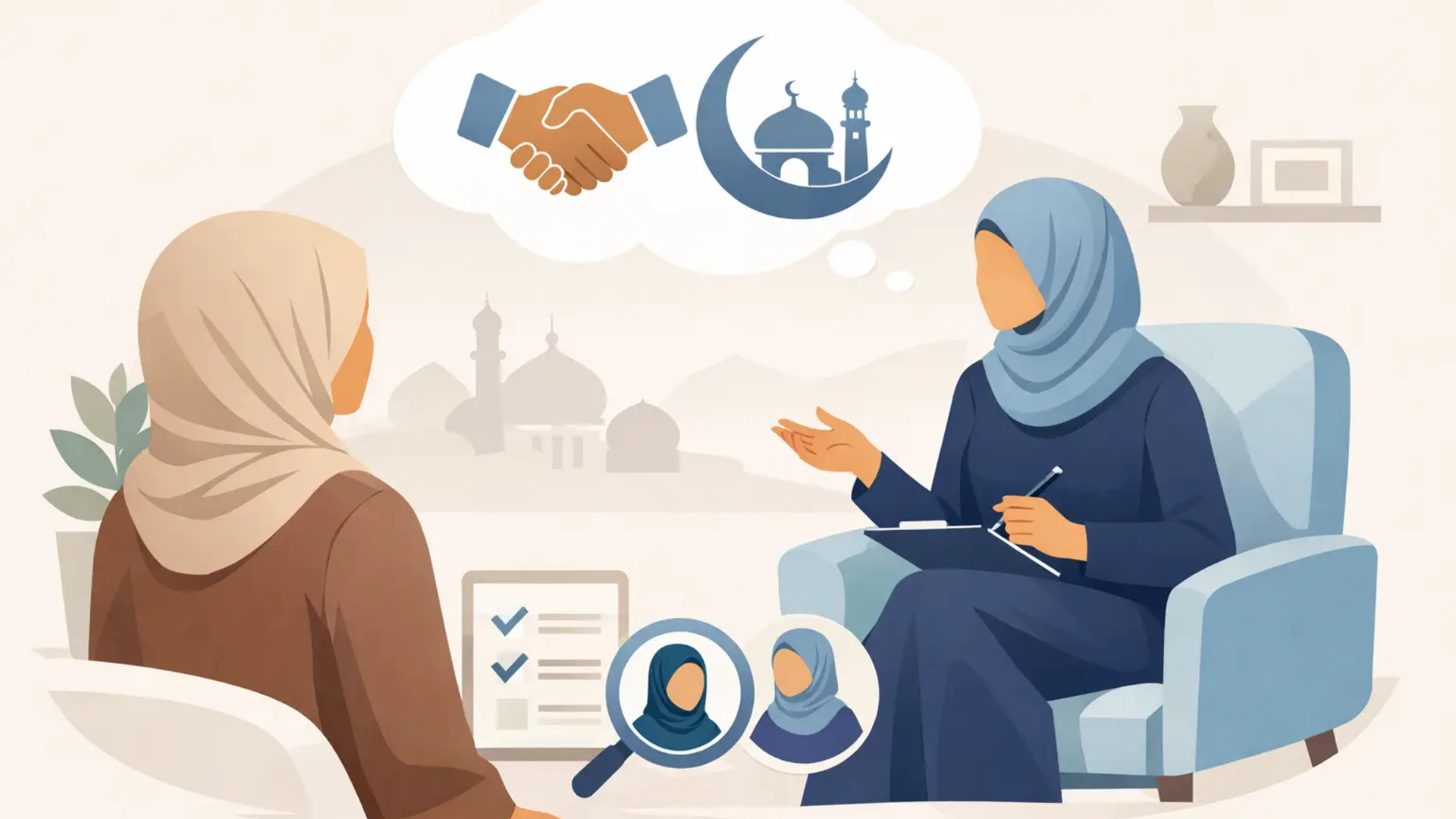
You may have spent years translating yourself in therapy: explaining why prayer matters, why certain family pressures carry real weight, or why intrusive thoughts about faith leave you frightened rather than comforted. Learning how to find a Muslim therapist can mean finding a space where you do not have to defend your devotion before you can begin to discuss your pain.
A Muslim therapist is not automatically the right therapist simply because she shares your identity. The goal is to find a licensed clinician whose clinical training, therapeutic approach, and religious fluency help you feel both understood and appropriately challenged. You deserve care that honors your relationship with Allah without reducing anxiety, trauma, OCD, or depression to a lack of iman.
Start With What You Need Help Carrying
Before searching, name what brings you to therapy. You do not need a perfect diagnosis to begin, but specificity will help you evaluate whether a clinician is equipped for your concerns. Perhaps you are functioning outwardly while feeling constantly on edge. Perhaps your body still reacts to an old wound as though it is happening now. Perhaps waswasa has become a cycle of checking, reassurance-seeking, guilt, and exhaustion.
A therapist who works broadly with stress may be a good fit for some concerns. But complex trauma, religious OCD, panic, chronic pain, postpartum distress, and longstanding depression often require more specialized treatment. Ask whether the therapist has experience with your presenting concern and which evidence-based approaches she uses.
For example, OCD treatment may involve Exposure and Response Prevention, or ERP, rather than repeated reassurance that you are a good Muslim. Trauma therapy may include EMDR, Cognitive Processing Therapy, Written Exposure Therapy, or Internal Family Systems. Anxiety and depression may benefit from Acceptance and Commitment Therapy, CBT, DBT skills, or a combination of approaches. Faith-informed care should deepen the work, not replace sound clinical treatment.
Know the Difference Between Shared Identity and Clinical Fit
It can be profoundly relieving to speak with a Muslim woman therapist who understands terms such as sabr, tawakkul, haya, fitrah, and barakah without needing a glossary. Shared context may reduce the burden of explanation and make it easier to discuss marriage, family, community, modesty, worship, and spiritual fear with honesty.
Still, shared identity is one part of fit. A therapist should also be licensed in the state where you are physically located for sessions, clear about her scope of practice, and able to explain how she treats the concerns you bring. She should not shame you, make religious rulings outside her expertise, or use Islamic language to push you past emotions that need care.
A faith-integrated therapist can acknowledge that prayer, Qur’an, dhikr, du’a, and community are meaningful sources of strength while also recognizing when your nervous system is overwhelmed, your thought patterns are compulsive, or your grief needs room to be witnessed. This is not a choice between spiritual and psychological healing. It is an effort to tend to both with integrity.
How to Find a Muslim Therapist: Practical Places to Look
Begin with therapist directories, Muslim mental health professional networks, referrals from trusted physicians, and recommendations from people who understand the kind of care you are seeking. Your local masjid may be able to suggest names, though it is wise to verify each clinician’s license, training, and specialization independently.
Telehealth can significantly widen your options, especially if you live in an area with few Muslim clinicians. It also has limits: a therapist must generally hold a license in your state, even when sessions are online. When reviewing a practice website or profile, look for the states where the clinician is licensed and whether they work with adults, adolescents, couples, or a specific population.
It may help to create a short list of three to five therapists and contact them for a consultation. You are not making a lifelong commitment by having an initial conversation. You are gathering information about whether this person can hold your story with competence, adab, and care.
Questions That Reveal Whether a Therapist Is a Good Fit
A consultation is not an audition in which you must prove that your suffering is serious enough. It is a chance to assess the therapeutic relationship. You can ask direct questions, including:
- “Do you integrate Islamic faith into therapy? What does that look like in practice?”
- “Have you treated trauma, OCD, intrusive thoughts, or the concern I am bringing?”
- “Which modalities do you use, and why might they be appropriate for me?”
- “How do you distinguish religious practice from anxiety-driven compulsions?”
- “What is your approach when family, culture, and faith are all part of the issue?”
Listen not only to the answers but also to how you feel while receiving them. A strong therapist will not promise a quick cure or claim to have every answer. She should be able to speak plainly about treatment, invite your questions, and respect your agency.
For some Muslim women, gender is an essential part of safety and comfort. For others, specialization, scheduling, insurance, or therapeutic style may carry more weight. There is no morally superior set of preferences. The right fit is the one that allows you to show up honestly and stay engaged in the work.
Pay Attention to How Faith Is Held in the Room
Religiously fluent therapy is not therapy with an occasional Arabic phrase added to it. It means your therapist understands that faith can be a source of grounding, moral orientation, hope, and belonging. It also means she understands that religious language can be tangled with fear, perfectionism, trauma, or community pressure.
Consider the woman with scrupulosity who repeats wudu, prayer, or repentance because she cannot tolerate uncertainty. Telling her simply to worship more may unintentionally strengthen the OCD cycle. A qualified therapist can help her use ERP to resist compulsions while honoring the actual requirements and mercy of the deen.
Consider the woman processing abuse, betrayal, or an emotionally unsafe marriage. She may need a therapist who can affirm the value of family while refusing to confuse endurance with accepting harm. Sabr is not passivity. Tawakkul does not require abandoning wise action, boundaries, or treatment.
This distinction matters because many Muslim women have been encouraged to spiritualize pain that requires clinical attention. Your tears, panic, numbness, anger, and exhaustion are not evidence that you have failed Allah. They may be signals from a mind and body that have been carrying too much for too long.
Review Logistics Without Apologizing for Them
The practical details shape whether therapy can become a consistent part of your life. Ask about availability, session length, fees, insurance or out-of-network reimbursement, cancellation policies, and the format of care. If you need evening appointments, virtual sessions, or a clinician licensed in a particular state, say so early.
Also ask about the level of support offered. Weekly outpatient therapy may be appropriate for many people, while intensive therapy can be useful when symptoms are severe, time is limited, or you need concentrated support. A responsible clinician will help you consider the level of care that fits your needs rather than selling a one-size-fits-all solution.
At Manara Counseling, Muslim women in eligible U.S. states can seek virtual care that brings together evidence-based psychotherapy and Islamic spiritual grounding. That combination is especially meaningful when your symptoms and your sacred commitments have felt impossible to discuss in the same room.
Give the Relationship Enough Time, Then Trust What You Notice
The first few sessions can feel unfamiliar. Therapy asks for a kind of honesty that many high-functioning women have learned to postpone. Feeling emotional, uncertain, or tired after a session does not necessarily mean the therapist is a poor fit.
But persistent signs of mismatch deserve attention. You may need a different clinician if you repeatedly feel judged, dismissed, rushed into disclosure, pressured to adopt the therapist’s personal views, or left without a clear sense of what treatment is addressing. You are allowed to ask for clarification, name what is not working, or seek a referral.
Healing is not measured by how quietly you endure. It can begin with one clear decision: to place your pain before someone who recognizes your dignity, understands the tools of clinical care, and helps you return to Allah with a steadier, more rooted soul.
