
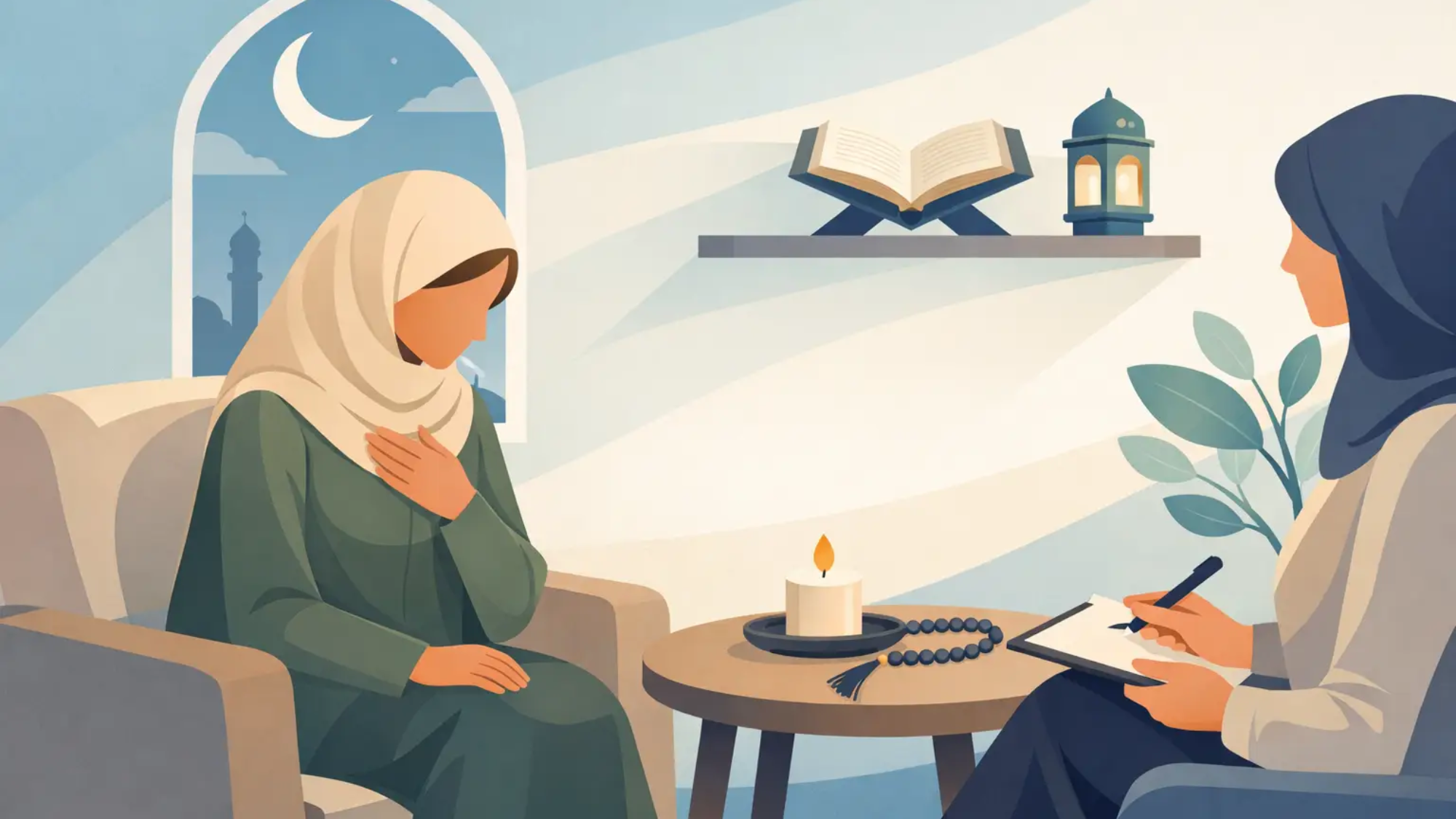
An anxious mind can make even meaningful acts feel heavy. You may love Allah, want to pray with presence, and still find your chest tightening before a meeting, your thoughts racing at night, or your body bracing for danger when no danger is visible. Islamic therapy for anxiety begins by refusing a false choice: you do not have to choose between serious mental health care and sincere devotion.
Anxiety is not proof that your iman is weak. It is often a learned alarm response shaped by temperament, stress, loss, trauma, chronic uncertainty, or painful experiences your body has not yet had the chance to process. Faith can be a profound source of comfort and direction, but it was never meant to become a weapon you use against yourself when you are suffering.
What Islamic Therapy for Anxiety Holds Together
Faith-integrated therapy makes room for both the nervous system and the soul. It takes your symptoms seriously while honoring the worldview that gives your life meaning. Rather than treating Islamic practice as an accessory to therapy, a Muslim clinician can understand how belief in Allah, worship, repentance, family obligations, modesty, grief, and hope for the Aakhirah may shape the way anxiety is experienced.
This does not mean every fear should be answered with a religious reminder. Sometimes a reminder is deeply regulating. Sometimes the most compassionate next step is learning how to recognize panic, challenge a catastrophic thought, set a boundary, or gently process a memory that still tells your body it is unsafe. Often, healing involves both.
For a Muslim woman, anxiety may carry layers that are easily missed in a generic clinical setting. You may fear disappointing your parents, feel guilty saying no, worry that you are not doing enough for your children, or hold yourself to an impossible standard of religious and personal perfection. You may have been told to simply make du’a, have sabr, or stop overthinking. These practices matter, but they are not substitutes for assessment and treatment when anxiety is disrupting sleep, relationships, work, worship, or your ability to feel present in your own life.
Anxiety Is Not One Experience
Anxiety can look like constant worry, irritability, muscle tension, insomnia, stomach distress, avoidance, people-pleasing, or a persistent sense that something terrible is about to happen. For some women, it appears as high achievement and over-functioning. Others feel frozen, disconnected, or unable to begin tasks that once felt manageable.
It is also essential to distinguish anxiety from conditions that may require more specialized care. Intrusive blasphemous thoughts, repeated reassurance-seeking, compulsive checking of wudu or prayer, and fear-driven repetition of religious acts can be signs of OCD or scrupulosity, often described in Muslim communities as waswasa. A person with OCD is not choosing these thoughts, nor are the thoughts a reflection of her character or faith.
Trauma can also resemble generalized anxiety. A body that has survived betrayal, abuse, medical harm, racism, displacement, or chronic emotional invalidation may remain watchful long after the original threat has passed. The goal is not to force yourself to “get over it.” The work is to help your mind and body learn, through safe and structured treatment, that the past is not still happening.
Why a careful assessment matters
A thoughtful therapist looks beyond the label of anxiety. She considers the intensity and duration of symptoms, the situations that trigger them, your physical health, sleep, trauma history, relationships, and the coping strategies that may be accidentally keeping the cycle alive. She also listens for the spiritual meanings you attach to your distress.
This matters because the right treatment depends on the pattern. Cognitive behavioral therapy, or CBT, may help when unhelpful interpretations and avoidance are maintaining worry. Acceptance and commitment therapy, or ACT, can support women who are exhausted from fighting every difficult thought and want to live according to their values even in the presence of uncertainty. Exposure and response prevention, or ERP, is a frontline treatment for OCD, including religious scrupulosity. Trauma-focused approaches such as EMDR, CPT, WET, or IFS-informed therapy may be appropriate when unresolved experiences are driving the alarm system.
Faith Is a Resource, Not a Measurement of Worth
Within Islamic therapy for anxiety, spiritual grounding is not used to pressure you into appearing calm. It can become a source of truthful orientation. Allah does not require you to deny your pain before you turn to Him. The Qur’an gives language to fear, grief, longing, patience, and reliance. The Prophets endured profound hardship, and their responses were not emotionally flat. They turned toward Allah with honesty.
This distinction can be healing for women who have internalized shame around mental health symptoms. You can make du’a and still need medication. You can pray and still benefit from ERP. You can trust Allah while taking practical precautions, seeking therapy, resting, grieving, and asking for help. Tawakkul is not passive resignation. It is faithful action with the knowledge that outcomes are ultimately held by Allah.
A therapist who is religiously fluent can help explore spiritual practices without turning them into compulsions or performance. For example, dhikr may be used as a gentle grounding practice, but not as a ritual you must repeat until anxiety disappears. Salah can be a place of return and connection, while treatment may also address the perfectionism that makes prayer feel terrifying. The difference is clinically and spiritually significant.
What Treatment Can Look Like in Practice
Therapy is not a lecture about what you should do better. It is a protected space to understand what is happening, practice new responses, and build a life that is larger than fear.
Early sessions may focus on mapping your anxiety cycle. You and your therapist might identify a trigger, the thought that follows, the body sensations that arise, and the behavior used to get relief. Perhaps you receive a message from a family member, assume you have done something wrong, feel panic in your chest, and send several apologetic messages. The temporary relief teaches your brain to repeat the cycle. Treatment helps you pause, name the pattern, and choose a response that serves your long-term wellbeing rather than anxiety’s immediate demands.
Depending on your needs, therapy may include nervous system regulation, cognitive restructuring, values-based action, trauma processing, boundary work, self-compassion, and carefully planned exposure exercises. A woman with panic may learn to stop fearing the sensations of a racing heart. A woman with OCD may practice allowing uncertainty without seeking reassurance. A woman carrying trauma may process memories in a paced way that preserves safety and choice.
The work can also include examining the stories you have inherited about being a good daughter, wife, mother, professional, or Muslim woman. Some of those values may be deeply life-giving. Others may have become fused with fear, self-erasure, or the belief that your needs are burdensome. Therapy does not ask you to abandon your values. It helps you live them with greater clarity, agency, and mercy.
When to Seek More Support
Consider reaching out to a licensed mental health professional when anxiety is persistent, escalating, or limiting your daily life. Support is especially warranted if you are experiencing panic attacks, intrusive thoughts, compulsive rituals, trauma symptoms, severe sleep disruption, hopelessness, or difficulty caring for yourself or your family.
If you are in immediate danger, thinking about harming yourself, or unable to stay safe, contact emergency services or a crisis resource in your area right away. Faith-integrated care is not separate from urgent care. Protecting life and seeking support are part of honoring the trust Allah has placed in you.
For Muslim women seeking virtual care, a clinician who understands both evidence-based treatment and Islamic tradition can remove the burden of having to translate the most sacred parts of your life before therapy can begin. At Manara Counseling, that integration is approached with clinical rigor, emotional safety, and reverence for each client’s story.
Your anxiety may be loud right now, but it is not the most truthful voice in your life. With skilled support, compassionate practice, and a return to Allah that makes room for your full humanity, you can learn to meet fear without letting it author your future.
