
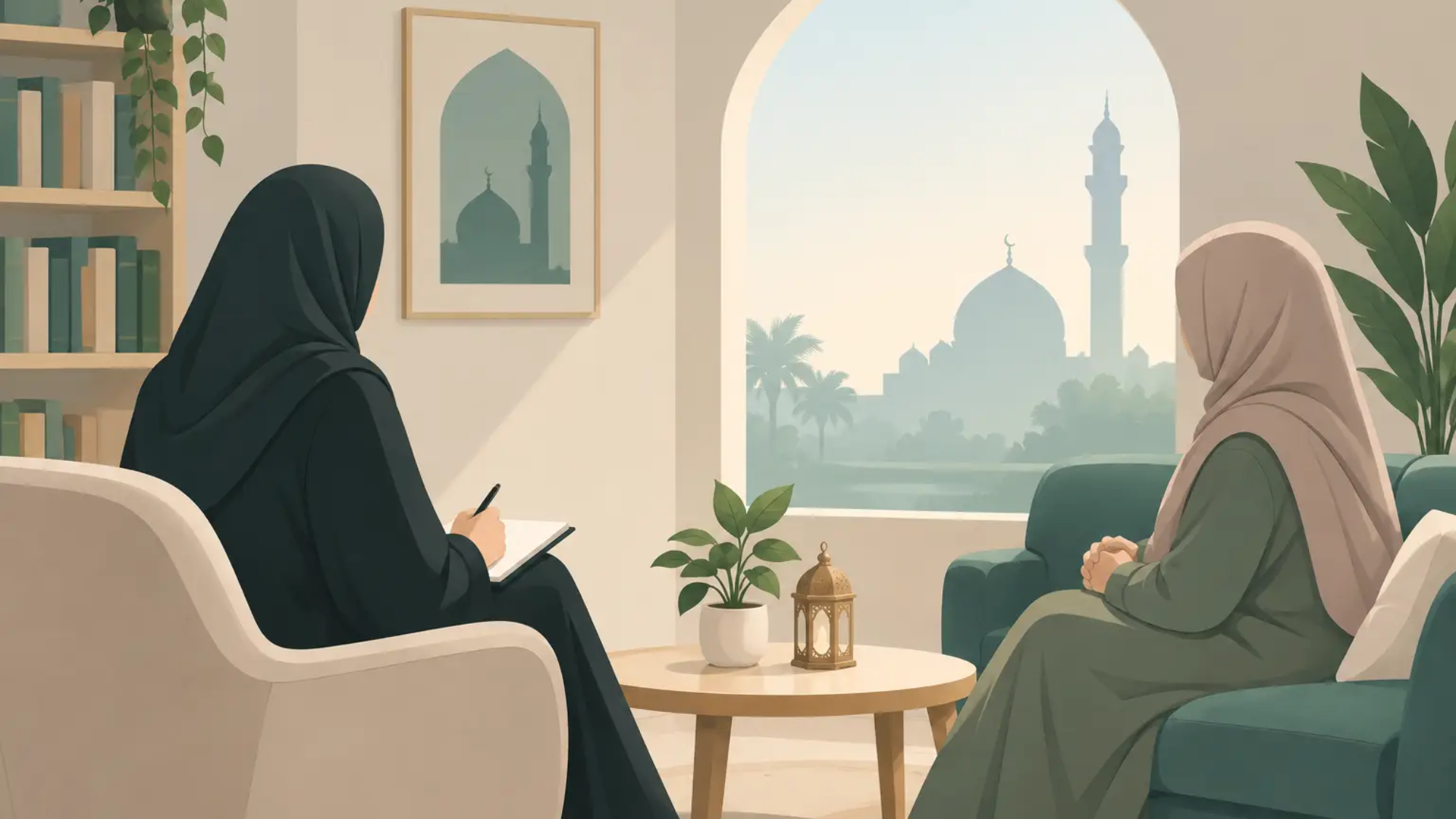
A woman can pray consistently, know that Allah is near, and still feel her body tighten at a harmless sound. She can love her faith deeply while intrusive thoughts make worship feel frightening. She can be grateful for her life and still be exhausted by depression. Islamic psychotherapy makes room for these truths at the same time: suffering is not proof of weak iman, and seeking skilled care can be part of a faithful return to Allah.
For many Muslim women, the hardest part is not simply carrying anxiety, trauma, or emotional pain. It is carrying it while wondering whether they should be able to fix it alone through more sabr, more du’a, or greater discipline. Faith is a profound source of healing. But faith should not be used to minimize a nervous system shaped by threat, grief, chronic stress, or trauma. Thoughtful therapy honors both the soul and the science of what the body and mind have endured.
What Islamic psychotherapy means in practice
Islamic psychotherapy is mental health treatment that integrates sound clinical care with an Islamic understanding of the human being. It recognizes that thoughts, emotions, relationships, physical health, behavior, and spiritual life affect one another. A therapist does not merely add a Quran verse to a standard treatment plan. She understands the religious language, values, moral concerns, and spiritual aspirations that may shape how a Muslim client experiences distress and healing.
This approach begins with clinical clarity. Anxiety, depression, obsessive-compulsive disorder, post-traumatic stress, and chronic pain are not vague personal failures. They have recognizable patterns, and effective care requires careful assessment. A client may need trauma processing through EMDR, Cognitive Processing Therapy, or Written Exposure Therapy. Someone with OCD may benefit from Exposure and Response Prevention, rather than repeated reassurance that unintentionally strengthens the obsessional cycle. A woman overwhelmed by intense emotions may need skills from DBT, CBT, ACT, or Internal Family Systems.
The Islamic dimension informs the meaning of this work. It can help a client distinguish healthy religious commitment from fear-driven perfectionism. It can make room for questions of tawakkul, repentance, grief, family duty, modesty, marriage, community belonging, and the desire to meet Allah with a heart that is more settled and sincere. The goal is not to force a spiritual interpretation onto every symptom. The goal is care that does not ask a Muslim woman to set aside her deepest commitments in order to be understood.
Faith integration is not spiritual bypassing
Some women have heard painful advice offered with good intentions: just make more du’a, read more Quran, be patient, or stop overthinking. These practices may be deeply nourishing, but they are not substitutes for treatment when someone is living with trauma symptoms, panic, compulsions, self-harm urges, major depression, or persistent emotional dysregulation.
Spiritual bypassing occurs when religious language is used to move too quickly past pain. It can leave a woman feeling ashamed that her suffering remains after she has prayed, fasted, sought forgiveness, or tried to be grateful. It may also discourage her from naming what happened to her, especially if the harm occurred within a family, marriage, or religious community.
Islamic psychotherapy holds a more compassionate standard. Sabr does not mean denying injury. Tawakkul does not mean refusing the means Allah has made available. Seeking care is not a departure from reliance on Allah. It can be an expression of it.
A clinically grounded Muslim therapist can also help with the places where mental health symptoms and religious concerns overlap. For example, waswasa may involve real theological concerns, yet OCD can attach itself to purification, prayer, intentions, or fear of disbelief. Reassurance and repeated checking may feel temporarily soothing while making the cycle stronger. Treatment requires sensitivity: neither dismissing the client’s faith nor treating compulsions as devotion.
How treatment can address the whole person
Good therapy is not a lecture on what a client should believe. It is a collaborative process that asks: What is happening? What has your mind and body learned in order to survive? What patterns are keeping you stuck? What kind of life do you want to build before Allah?
For trauma, treatment may begin by helping the nervous system develop enough safety and stability to approach painful memories without becoming overwhelmed. A client might learn to recognize triggers, notice protective responses such as shutting down or people-pleasing, and practice grounding skills that work in her real life. When appropriate, trauma-focused modalities can help the memory become integrated rather than continually relived.
For anxiety, therapy may examine catastrophic thinking, avoidance, reassurance-seeking, and the physical cycle of fear. For depression, care may address withdrawal, hopelessness, depleted energy, self-criticism, grief, and the loss of meaningful connection. When chronic pain is present, treatment can support nervous system regulation and values-based living without implying that pain is imaginary or self-created.
Faith integration can be woven into these clinical interventions with care. A client may explore the difference between guilt that guides repair and shame that says she is beyond mercy. She may notice how an image of Allah as only disappointed or distant affects her inner world, then return to the breadth of divine mercy without using religion to deny accountability. She may clarify values rooted in worship, family, service, dignity, or justice, and use those values to guide small, sustainable actions.
This is where healing becomes more than symptom reduction. Relief matters. Sleeping more peacefully, praying without panic, feeling less controlled by intrusive thoughts, and having more capacity for relationships all matter. Yet many women also seek something deeper: a rooted soul, a clearer sense of agency, and an Aakhirah-focused life that is no longer organized around fear.
Islamic psychotherapy is not one-size-fits-all
The degree of explicit faith integration should fit the client. Some women want Quranic reflection, Islamic concepts, and spiritual practices named directly in sessions. Others want to know that their therapist understands Islam while keeping the clinical work in the foreground. Both preferences are valid, and they can change over time.
Likewise, not every problem needs a religious explanation. A panic attack may require breath work, exposure, and an assessment of sleep, caffeine, medication, or medical factors. A marriage conflict may require communication skills, boundaries, and a clear-eyed look at safety. Trauma may need specialized treatment rather than general supportive counseling. A faith-integrated therapist can respect spiritual meaning while remaining disciplined about what the clinical picture calls for.
It also matters that therapy is culturally responsive without making assumptions. Muslim women are not a monolith. Race, ethnicity, immigration history, disability, class, family structure, and experiences of Islamophobia can shape distress and access to support. A therapist should be curious enough to understand a client’s particular story, not simply presume that shared religious identity supplies every answer.
What to look for in a therapist
A therapist who offers Islamic psychotherapy should be able to speak competently about both mental health treatment and faith integration. Ask how they assess OCD versus religious scrupulosity, how they treat trauma, and what modalities they use. If you are seeking help for a specific concern, such as intrusive thoughts, panic, abuse, or chronic pain, ask about their relevant training and experience.
It is also reasonable to ask what therapy will feel like. Will the therapist make space for your spiritual goals? Will she challenge harmful perfectionism without dismissing your desire to practice Islam sincerely? Does she understand the difference between cultural pressure and Islamic obligation? The right fit is not a therapist who agrees with every thought or makes every decision for you. It is someone who offers safety, expertise, honesty, and respect for your agency.
For Muslim women seeking virtual care, privacy and practical fit matter as well. Confirm licensure in your state, telehealth policies, scheduling, fees, and whether the level of care matches your needs. At Manara Counseling, this work is shaped by a commitment to evidence-based treatment and Islamic scholarship, so clients do not have to choose between clinical rigor and devotion.
You do not need to earn support by reaching a breaking point. The pain you have learned to carry quietly deserves compassionate attention. Taking one honest step toward care can be a form of courage, and a form of trust that Allah’s mercy includes the means of healing.

Leave Your Comment
You must be logged in to post a comment