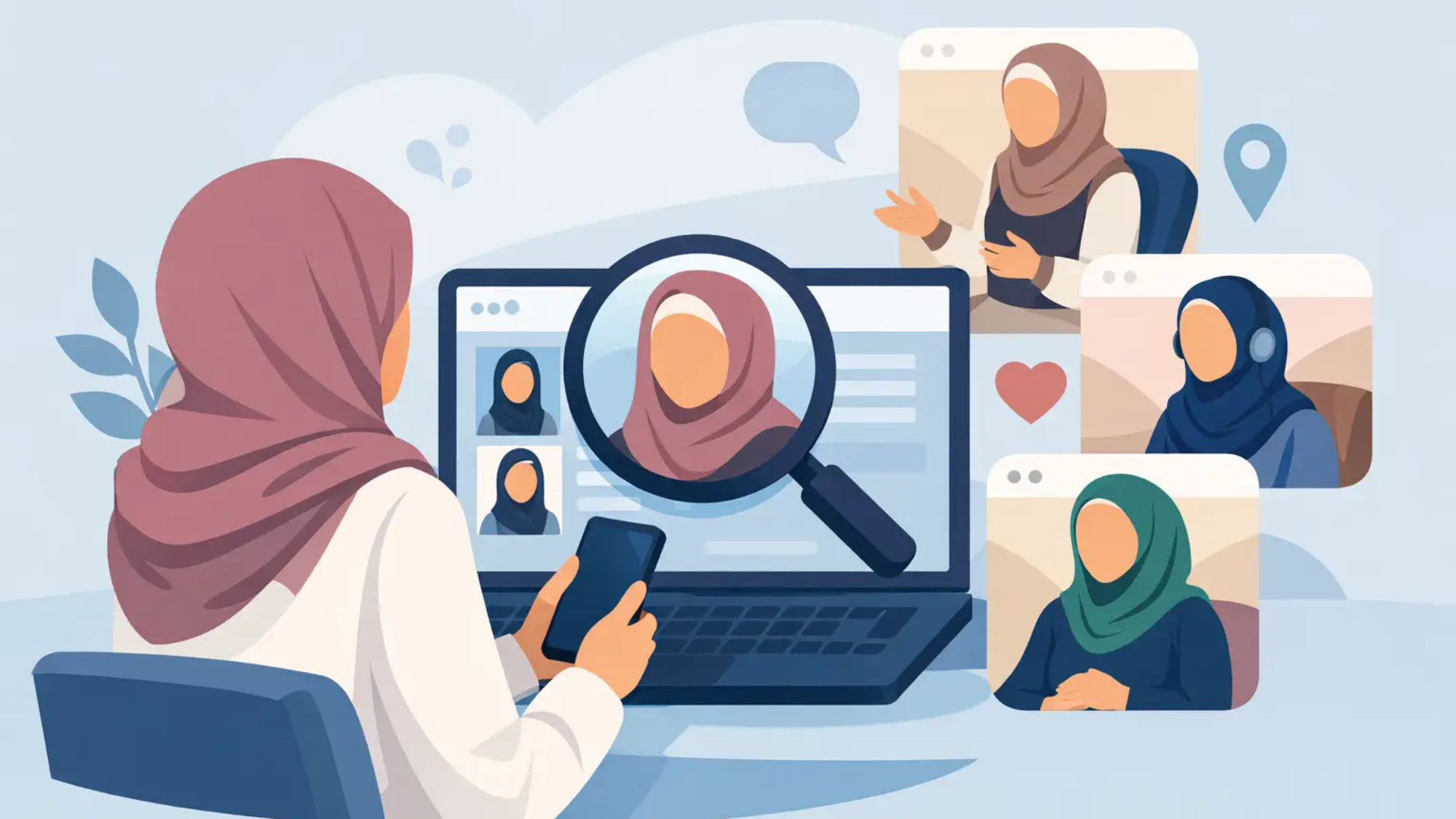
Some wounds get quieter in public and louder at night. You may be functioning well enough to meet deadlines, answer messages, and show up for others, yet still feel internally burdened by anxiety, intrusive thoughts, grief, numbness, or a private exhaustion that never fully lifts. In that space, searching for a Muslim female therapist online is not a small decision. It is often an act of honesty, courage, and return.
For many Muslim women, the search is not only about finding a licensed clinician. It is about finding someone who understands that faith is not an accessory to life. It shapes conscience, relationships, grief, hope, and the meaning of suffering. When therapy ignores that reality, even skilled care can feel incomplete. When therapy misuses religion or reduces deep pain to simple reminders to make dua, the harm can deepen.
A good therapeutic relationship should never force you to split yourself in two. You should not have to choose between clinical excellence and devotion to Allah, between evidence-based treatment and an Islamic frame for healing. The right care can hold both.
Why a Muslim female therapist online can feel different
There is a particular relief in being understood without having to translate every layer of your life. A Muslim female therapist may already understand concerns around modesty, family dynamics, marriage expectations, spiritual guilt, community stigma, and the complexity of carrying both religious commitment and emotional pain. That does not mean every Muslim therapist is the right fit, or that shared identity alone creates safety. But it can reduce the burden of explanation and make room for deeper work sooner.
The online format matters too. Virtual therapy expands access for women who live in areas with few Islamically grounded clinicians, who need privacy, who travel, who manage childcare, or who simply feel safer opening up from their own space. For some clients, being at home softens the intensity of the first sessions. For others, online therapy is not just convenient. It is the only realistic path to consistent care.
That said, online therapy is not automatically better. It depends on your environment, your symptoms, and your ability to speak freely where you are. If your home is chaotic, unsafe, or lacking privacy, virtual sessions may require more planning. Good care accounts for those trade-offs rather than pretending one format fits everyone.
What to look for in a Muslim female therapist online
Start with licensure and clinical training. Warmth matters, but so does competence. If you are dealing with trauma, OCD, panic, depression, chronic pain, or longstanding relational wounds, your therapist should be trained in more than supportive conversation. You want someone who can assess patterns clearly and use treatment methods that have real clinical weight.
That may include approaches such as CBT for distorted thinking patterns, ERP for OCD and scrupulosity, EMDR for trauma processing, ACT for values-based action, DBT for emotion regulation, IFS for inner conflict, or CPT and WET for trauma-related symptoms. You do not need to become an expert in acronyms before starting therapy. But it is wise to ask how your therapist works and whether her methods fit the kind of suffering you are carrying.
You should also look for religious fluency, not just religious familiarity. There is a meaningful difference between a therapist who is culturally Muslim and one who can responsibly integrate Islamic concepts into treatment without spiritual bypassing. Faith-integrated therapy should not shame you, pressure you, or flatten your struggle into a character issue. It should help you understand how your nervous system, thoughts, emotions, behavior, and spiritual life interact.
A strong therapist can say, in effect, that your tawakkul matters and your trauma responses matter. Your dhikr matters and your panic symptoms matter. Your longing to please Allah matters and so does the way your mind may misfire under stress. That kind of integration is careful, not simplistic.
Signs the fit is right
The right fit often feels less like instant comfort and more like grounded safety. You may feel seen, but also challenged with wisdom. You may leave sessions emotionally tired yet clearer. You may notice that your therapist does not rush to reassure you in ways that strengthen avoidance, nor does she dismiss your distress because you “look high functioning.”
A good fit also means your therapist can distinguish between spiritual concerns and clinical symptoms. This is especially important for women dealing with OCD or waswasa. Intrusive thoughts about purity, prayer, sin, or blasphemy can be terrifying, and they are often misunderstood by family, community members, and even some professionals. If a therapist does not understand the difference between a sincere spiritual conscience and an obsessive fear cycle, treatment can become muddled.
The same is true for trauma. Not every painful memory is PTSD, and not every verse or reminder is sufficient care for a dysregulated body. Trauma treatment requires pacing, skill, and discernment. If therapy keeps you talking about painful experiences without helping your nervous system process them, you may feel stuck in retelling rather than healing.
Questions to ask before you begin
It is appropriate to ask direct questions during a consultation. You are not being difficult. You are discerning who will hold vulnerable parts of your story.
Ask how the therapist integrates Islam into treatment. Ask whether she has experience treating the specific issue you are facing, whether that is OCD, trauma, anxiety, depression, or chronic pain. Ask what therapy with her typically looks like and how progress is measured. If faith matters deeply to you, ask how she handles situations where religious practice, guilt, and mental health overlap.
You can also ask practical questions that affect consistency, such as state licensure, scheduling, fees, privacy, and the structure of sessions. Therapy is not only about insight. It is also about whether the care is accessible enough to continue.
What therapy should not feel like
Therapy should not feel like being judged for struggling. It should not feel like a debate about whether your faith is strong enough. It should not leave you constantly explaining basic Islamic concepts or defending why religious congruence matters to you.
It also should not feel vague for months on end. Healing is not linear, and deep work takes time. Still, good therapy has direction. Your therapist should be able to help you name what is happening, why certain patterns persist, and what treatment is targeting.
If you leave session after session with momentary comfort but no increasing clarity, no practical tools, and no deeper understanding of your inner world, something may be missing. Support matters, but structure matters too.
When faith-integrated care changes the process
For many Muslim women, one of the deepest pains is feeling that their inner life has been misread. Sometimes serious symptoms are minimized as weak iman. Sometimes genuine spiritual concerns are pathologized by clinicians who do not understand Islamic practice. Both errors can delay healing.
Faith-integrated therapy offers another path. It allows treatment to honor the reality that human beings are psychological, relational, physical, and spiritual at once. It can help you examine perfectionism without mocking your sincerity. It can address shame without excusing wrongdoing. It can support repentance, boundaries, grief, and nervous system regulation in the same therapeutic space.
This is where clinically rigorous, Islamically grounded care becomes especially meaningful. Practices like EMDR, ERP, ACT, and CBT do not compete with faith when used wisely. They can become part of how a woman learns to respond to fear without surrendering to it, to carry pain without becoming defined by it, and to live with greater steadiness before Allah. That is part of what practices such as Manara Counseling seek to offer Muslim women across participating U.S. states through online care.
Choosing with both wisdom and hope
If you are looking for a Muslim female therapist online, trust that your criteria are not excessive. Wanting a therapist who understands Islamic values, female experience, and complex mental health is not a luxury. For many women, it is the difference between feeling vaguely helped and being deeply treated.
Take your time, but do not let fear keep postponing support. You do not need to be in crisis to begin. You do not need to have the perfect language for your pain. You do not need to wait until everything falls apart.
Sometimes healing begins with a very quiet step – admitting that what hurts deserves care, and believing that tending to your mind and heart can be part of your faithfulness, not a departure from it.

Leave Your Comment
You must be logged in to post a comment